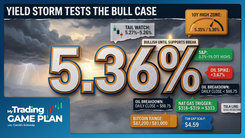

My Trading Game Plan Revealed - 06/11/2026: Hot PPI, S&P 500 Top Signals and IPO Liquidity Crunch

Hot producer-price data, rising financing activity across AI-related companies, and a possible change in the S&P 500's trend structure are creating a more fragile market backdrop. In today's My Trading Game Plan Revealed, Gareth Soloway, Chief Market Strategist at Verified Investing, broke down the technical signals that matter now — including the developing lower-low structure in the major indices, dilution risk in AI names, and key levels across oil, gold, Bitcoin, and large-cap technology.
The Inflation Threat: Why PPI Is the Canary in the Coal Mine
The macroeconomic picture grew more complicated this morning with the release of Producer Price Index (PPI) data. The numbers came in hot across the board. Headline year-over-year inflation hit 6.5%, above the market's forecast of 6.4%. Month-over-month, producer prices rose 1.1% against an expected 0.7%.
To understand why the market reacted negatively, consider the mechanical relationship between producer prices and consumer prices. As Gareth explained on the show:
"What we know is that prices rise for the producers or the businesses first, and then they pass it along down the line to the consumer. So anytime you see hot numbers on PPI, you have to assume that within a few months, that's going to translate into hot numbers in the CPI data."
The PPI acts as a leading indicator for the Consumer Price Index. When manufacturers, wholesalers, and businesses face higher input costs, they may attempt to pass those costs through to consumers — though the degree of pass-through depends on margins, demand, and competitive conditions. This hot PPI print suggests the inflation narrative is not resolved, which complicates the Federal Reserve's interest rate trajectory and adds fundamental pressure to equity markets.
The S&P 500's Technical Top: Three Nails in the Coffin
The S&P 500 is exhibiting what Gareth describes as textbook topping behavior, assessed through a probability-based framework.
Yesterday, the index dropped 1.62%. More important than the magnitude was the structural damage: the S&P officially registered a lower low daily close. Gareth breaks the anatomy of a market top into three distinct phases, each increasing the probability of a cycle high being in place:
Nail 1 — The Lower Low Wick (60% probability): Two days ago, the market printed a wick that dropped below the previous structural low. Gareth assigns roughly a 60% probability at this stage that a major high is being established.
Nail 2 — The Lower Low Daily Close (70% probability): Yesterday provided the second confirmation. By closing the daily session below that previous low, the market reinforced the structural breakdown. "Once you get a daily closing lower low, now you have about a 70% chance that there's a major high being put in," Gareth noted.
Nail 3 — The Lower High Bounce (80% probability): The final confirmation requires a bounce that fails to reach the prior high — a lower high. Once both a lower low and a lower high are established, Gareth's framework assigns roughly 80% probability that the trend has changed.
This staged approach lets traders use Gareth's framework to assess whether the evidence of a trend change is strengthening — rather than reacting emotionally to each day's move.
The Great Liquidity Vacuum: IPOs and Massive Dilution
One of the most significant themes in today's game plan is the impending liquidity drain. SpaceX is set to price its IPO tonight and begin trading tomorrow on Nasdaq under the ticker SPCX. At a target offer price of approximately $135 per share, the deal is targeting a valuation in the range of $1.75 trillion, which would make it the largest IPO in market history. With Anthropic — which has filed a confidential S-1 and is targeting a listing later this year — and OpenAI reportedly preparing for a potential public offering in Q4, Gareth argued the market faces an unusual concentration of large capital events in the months ahead.
When mega-cap companies go public, institutional and retail investors must free up cash to participate, which can create a headwind for existing equities. Gareth's view is that this dynamic is prompting current public companies to accelerate their own capital raises while the window remains open.
The fallout for specific AI-adjacent names has been significant. Super Micro Computer (SMCI) announced a $7 billion financing plan — combining a $1.25 billion common stock offering, $3.75 billion in depositary shares tied to mandatory convertible preferred, and an at-the-market program of up to $2 billion. The stock dropped sharply on the news, with reports indicating a decline in the range of 20% or more. Relative to SMCI's recent market value, the financing is substantial and could result in meaningful dilution, particularly through the common-stock and equity-linked portions.
Alphabet (Google) announced an $80 billion equity capital raise to fund AI infrastructure investment — its first major equity issuance since its 2004 IPO era, according to SEC filings. The raise was subsequently upsized and priced. Gareth framed it as another example of large technology companies securing capital ahead of a crowded issuance calendar.
Oracle's Debt Dilemma and Technical Breakdown
Oracle's financing situation drew particular attention. According to its SEC filings, Oracle announced plans to raise $45 to $50 billion in gross cash proceeds during the 2026 calendar year to fund Oracle Cloud Infrastructure expansion, with up to $20 billion coming from an equity distribution program involving common stock sales. The stock came under pressure on earnings as the market weighed this dilution against the company's existing debt load.
From a day-trading perspective, Gareth identified a level near $172 where a gap fill aligns with a multi-point trendline. His swing trade target, however, reflects a much more cautious outlook:
"As a swing trade, I'm looking at like $135 to $140 way farther lower… number one, it looks like the bubble is breaking on the AI trade. Number two, Oracle has put itself in a position where literally their survival might be at risk if they don't make a lot of money on all of the deals that they're doing."
That quote reflects Gareth's view. Stated differently, Oracle's aggressive financing commitments increase execution risk significantly if AI-related returns fail to meet expectations.
Geopolitics vs. Price Action: The Oil Anomaly
Crude oil is presenting a divergence between headlines and price action. Despite continued escalation between the US and Iran in the Strait of Hormuz, oil traded down 1.7% today.
Traders who reflexively buy oil on Middle East conflict headlines have repeatedly been caught offside. The chart tells a different story. Oil has broken out of a bearish wedge pattern to the downside. Within Gareth's framework, the wedge breakdown raises the probability of further downside into the 65% to 70% range.
His theory on the geopolitical disconnect: the market may be pricing in the possibility that increased US pressure is a calculated move to force a deal ahead of the upcoming midterms, reducing the risk premium in oil.
Simultaneously, the 10-year Treasury yield is holding a critical trendline connecting pivot highs from January 2025, March 2026, and May. As long as yields remain above this support, they have room to push higher, especially if employment data stays resilient. Higher yields act as a headwind for growth stocks and non-yielding assets, adding another layer of pressure on the broader market.
Tech Setups: Gap Fills and Bearish Continuations
Amazon and Google: Both are approaching significant gap-fill levels. Amazon has a clear gap fill at $233, while Google is nearing its own gap support. Gap fills tend to act as price magnets and can create technically significant bounce zones for disciplined swing traders.
Micron (MU): After dropping to $866 in overnight trading and bouncing near $910, Micron's daily chart is forming an inside bar — a pattern where a day's entire range falls within the prior day's high and low. Following a sharp decline, this can act as bearish consolidation before the next leg lower, though a break above the recent high would invalidate that setup. Gareth noted this as a pattern to watch rather than a confirmed signal.
Apple (AAPL): Apple flushed into a support zone Gareth had identified the prior session and violently rejected it, surging sharply higher. Gareth cautioned that he views the move as a short-term bounce, with the expectation that support will eventually give way as broader market weakness continues.
Precious Metals and Crypto: Shifting Correlations
Gold and Silver Under Pressure
Gold has been under significant pressure. After piercing the $4,100 level, it is currently attempting to reclaim that pivot low as support. If $4,100 fails to hold, Gareth sees a near-term area just below $4,000, with a longer-term downside target for potential accumulation in the $3,500 to $3,600 range.
Silver is facing similar conditions, having briefly broken below $64. A confirmed breakdown targets $54, with Gareth watching the $50 area as a longer-term reference.
The more important signal from precious metals is the correlation structure:
"The stock market's been falling, gold's been falling off a cliff. You need that dynamic to flip back to what we're used to, which is more like people exiting the stock market and then going into gold for safety."
Gold is currently trading as a risk-on asset, declining alongside equities. For a durable base to form, the correlation needs to flip — where equity weakness drives capital into gold as a store of value. Until that shift occurs, Gareth views premature bottom-calling in gold as high-risk.
Bitcoin's Bullish Micro-Structure
Bitcoin caught a bid today, forming a double bottom on the daily chart. The current candle's low aligns with the lows of the prior two sessions, and as long as Bitcoin avoids a daily red candle close below this cluster, it is forming a bullish inside bar pattern. By holding around $60,700, Bitcoin presents a short-term bullish swing trade setup in Gareth's view.
He was clear about the context, though: while the micro-structure is constructive in the near term, the broader macro environment for risk assets creates longer-term headwinds.
Conclusion: Discipline Over Narrative
Today's environment is difficult for traders without a defined process. Hot PPI data threatens to reignite CPI inflation, large capital raises are pressuring AI sector names, and the S&P 500 may be establishing the topping structure Gareth has been watching for.
The practical edge here isn't a macro call — it's process. Gareth's staged probability framework on the S&P, his timeframe discipline separating day-trade levels from swing targets in names like Oracle, and his willingness to let price confirm the setup before acting are the throughline of today's analysis.
The coming sessions will be telling. Does the S&P print the lower high that would push Gareth's top probability to 80%? Does the SpaceX IPO absorb institutional attention and pressure existing tech names? Traders with predefined levels and clear risk parameters are better positioned to act on what the market confirms — rather than what narratives suggest.
Patience remains one of the trader's most valuable disciplines.
Trading involves substantial risk. All content is for educational purposes only and should not be considered financial advice or recommendations to buy or sell any asset. Read full terms of service.