
My Trading Game Plan Revealed - 06/12/2026: SpaceX IPO, AI Mega Caps and Key Market Technicals

The SpaceX IPO, renewed Iran-deal speculation, and several major technical tests are creating an unusually active market backdrop. In today's My Trading Game Plan, Gareth Soloway, Chief Market Strategist at Verified Investing, broke down the liquidity questions surrounding the debut, the relationship between oil and Treasury yields, and key setups in Microsoft, Alphabet, Adobe, gold, and Bitcoin.
The SpaceX IPO: Allocation Mechanics and Day-One Discipline
Today marks the first trading day for SpaceX (SPCX) on the Nasdaq — an event that has already pushed Elon Musk's net worth above $1 trillion, making him the first person to reach that threshold, according to calculations by Forbes and Reuters based on his approximate 42% stake in the company at the $135 IPO price.
The mechanics of this offering reveal a meaningful divide between institutional and retail access. SpaceX initially planned to allocate roughly 30% of shares to retail investors — an unusually generous figure for a deal of this size, where the typical retail allocation runs in the single digits. That figure has since been trimmed to the low 20% range, according to CNBC, as institutional demand overwhelmed the book-building process. BlackRock alone placed a $5 billion order. Retail investors, meanwhile, submitted orders exceeding $100 billion according to Bloomberg — for a tranche representing a fraction of that.
This dynamic is worth understanding before deciding how to approach day-one trading. Gareth was direct about his own posture:
"I don't buy IPOs when they open to the public. Generally, it's a 50-50. I have no chart data, which is what I use to predict and give me probabilities."
New listings arrive without established support levels, resistance zones, or moving averages. Facebook's IPO is the canonical example: despite extraordinary pre-IPO hype, the stock lost roughly half its value within three months of its debut before recovering. Trading a new listing on day one without technical structure is not trading — it is speculation. When strong retail demand creates the liquidity that allows early investors and pre-IPO holders to reduce exposure at the opening price, the day-one buyer is often on the other side of that trade.
The SpaceX halo effect is already creating volatility in adjacent space names. Rocket Lab (RKLB) — which announced this morning that it will join the Nasdaq-100 effective June 22 — saw a significant pre-market surge before fading. Similar speculative activity has appeared in ASTS and Virgin Galactic (SPCE). These are sympathy moves, not fundamental changes; they deserve caution rather than momentum-chasing.
On the Hyperliquid synthetic pre-IPO perpetual market, which has been active since May 17th, SpaceX contracts saw highs near $200 and approached $230 at one point, according to Gareth's chart review. The current range around $172 to $173 informed his expectation of an opening price near $175. These are not the Nasdaq-listed shares — they are synthetic instruments reflecting speculative positioning — and should not be treated as a reliable opening price guide.
Macro Catalysts: Oil, Inflation, and the Bond Market
While attention is concentrated on the IPO, the macro backdrop is being shaped by two competing forces: energy prices and debt dynamics.
The market is pricing in the possibility of a new agreement involving Iran — a narrative that has circulated repeatedly in recent weeks. Yesterday, that expectation sent oil prices sharply lower toward $85, with the commodity currently hovering near $85.50. From a technical perspective, oil broke down from a bearish wedge pattern, bounced as expected, and has since resumed establishing lower lows. Even as deal speculation fades and revives, oil has failed to reclaim its prior highs — a sign of underlying technical weakness independent of the headline.
Lower oil prices carry a direct implication for inflation. This week's CPI and PPI data came in hot, confirming that inflation remains a concern. Lower energy prices would provide one of the fastest paths to easing headline inflation — which creates a political dimension to the oil move given upcoming midterm elections, though the market's primary driver remains the technical and positioning picture.
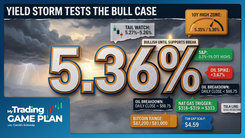
The bond market, however, is complicating the picture. The 10-year Treasury yield initially fell on the oil drop but has since bounced back. Gareth posed the central question: if oil were to drop further to $70 a barrel, would the 10-year yield fall toward 4%, or would it remain stubbornly near 4.5%? If yields hold elevated despite falling energy costs, the bond market may be signaling concern about a larger structural issue — the US national debt, which is rapidly approaching $40 trillion. That scenario would represent a more difficult environment for equities than a simple oil-driven disinflation trade.
S&P 500: Anatomy of the Bounce and What Comes Next
The broader equity market staged a sharp rally yesterday, avoiding what had looked like a technically dangerous close. At 1:00 PM, the S&P 500 was on the verge of turning negative for the day. Given the selling pressure into the prior close, that outcome carried meaningful downside risk. Instead, the market caught a significant bid.
The bounce occurred at a well-defined technical level — specifically, a major multi-year trendline connecting the bull market high of 2021 through the high of 2025. When price retraced to that pivot high, it found textbook support.
That said, a bounce became more likely as price reached major technical support, and a bounce alone does not confirm the trend. As Gareth noted, the true test is what comes next. If the S&P 500 rallies only to form a lower high and then a lower low, it will confirm the trend change from bullish to bearish that his framework has been tracking.
Understanding current equity dynamics requires understanding the market's primary engine. As Gareth noted on the show, AI-related leaders now represent an unusually large share of major U.S. equity-market value — a concentration that makes the major indices heavily dependent on a handful of tech names. We saw this play out in Micron, which staged a sharp end-of-day rally from $900 toward $1,000. When the AI complex catches a bid, it moves the broader index with it.
Big Tech: Gap Fills and Technical Setups
The volatility in tech has created several clean technical setups, particularly in names that have recently filled major price gaps. When stocks gap significantly, those untraded zones often become reference points for future price action — and once filled, the stock frequently sees a sharp directional reaction.
Microsoft: Microsoft recently declined in a near-straight line from $466 down to a low of $384 — an unusual magnitude of correction for a company of its size. That sell-off drove price directly into a major pivot-high gap fill. Having filled that gap, the stock is positioned for a technical swing trade bounce, with near-term targets in the $405 to $410 range.
Alphabet (Google): Google showed a nearly identical setup. A major daily gap acted as a downside magnet, and yesterday the stock hit a low of $346.50, filling the gap precisely before catching a bid and bouncing to $361. This is the kind of setup that rewards patience and chart preparation over reactive decision-making.
Adobe: Adobe's setup involves an unusual fundamental-technical disconnect. The company beat revenue estimates, beat earnings-per-share estimates, and raised forward guidance — a strong fundamental result by any standard. The stock sold off regardless, in part due to the announced departure of its CFO, which tends to unsettle institutional holders, and in part due to broader sector concern about AI's impact on traditional software business models.
The selling has pushed Adobe to multi-year lows not seen since 2018–2019. With major technical support sitting just below $200, Gareth views this as a technically significant area for patient swing traders to monitor — a case where price may be getting ahead of the fundamental picture, though confirmation remains required.
Precious Metals and Crypto: The Safe-Haven Divergence
The precious metals market is flashing an unusual correlation signal. Gold bounced yesterday, reacting to the $4,100 support level Gareth had previously identified. The bounce itself is technically logical. What is less logical is why it bounced: gold rallied in tandem with a 2.5% surge in the Nasdaq.
Gold's historical role is as a safe-haven asset — one that tends to rally when equities fall, as capital seeks protection. When gold begins trading as a risk-on asset, rallying simply because tech stocks are rallying, it signals that gold's safe-haven behavior is not currently dominating price action. Combined with a series of lower highs and lower lows on its chart, the technical posture remains cautious. The correlation needs to flip before a durable base can form.
Silver found support at its $66.64 level. Unlike gold, silver carries significant industrial applications, making it more naturally correlated with broader economic activity and risk-on sentiment. Its bounce alongside equities is therefore less concerning from a structural standpoint.
Natural gas remains flat. Gareth is watching for a confirmed break above the daily 200-day moving average before adopting a directional view.
Bitcoin is building what Gareth describes as a constructive inside bar pattern on the daily chart. Following a strong green candle, Bitcoin has spent three sessions consolidating without closing below that candle's low. The setup has clearly defined parameters: a break above $64,200 (the high of the initiating green candle) opens the door for a potential move toward the $73,000 to $75,000 zone — roughly the 50% to 61.8% Fibonacci retracement range. A daily close below the $60,700 to $60,800 support zone would invalidate the bullish setup and signal further downside.
Conclusion: Structure Over Hype
The SpaceX IPO will dominate financial media today. That is precisely when discipline matters most. Without historical chart data, moving averages, or established support and resistance, a first-day IPO trade offers no technical edge. As Gareth puts it, the financial markets are an arena for logic, mathematics, and probability — not a reaction to headlines.
By waiting for the IPO dust to settle, identifying precise gap-fill levels on mega-cap tech names, and tracking the macro relationship between oil, yields, and the $40 trillion debt trajectory, traders can approach this environment with defined risk rather than FOMO-driven exposure.
The S&P's ability to hold the trendline reclaimed yesterday, and whether it produces a lower high on the next rally attempt, will tell more about the market's condition than any IPO opening print.
Define the level, wait for confirmation, and let price determine whether the setup is real.
Trading involves substantial risk. All content is for educational purposes only and should not be considered financial advice or recommendations to buy or sell any asset. Read full terms of service.