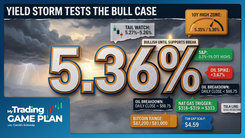

My Trading Game Plan Revealed - 12/08/2025: Fed Commentary, Japan Yield Shock and Tech Risk Levels

As the market enters a pivotal week, all eyes are on the Federal Reserve's upcoming interest rate decision. This single event holds the power to dictate market direction for weeks to come, but as Gareth Soloway, Chief Market strategist at Verified Investing, detailed in this morning's My Trading Game Plan, it's far from the only factor traders should be watching. From blatant signs of insider activity to a brewing storm in international bond markets, the charts are telling a complex story that requires a disciplined, probability-based approach to navigate.
This article will expand on the key themes from this morning's show, providing deeper context on the macro pressures, the technical levels that matter most, and the psychological discipline required to trade in this environment.
The Fed Decision: It’s Not the Cut, It’s the Commentary
The market is bracing for the Federal Reserve's announcement this Wednesday, with a 25-basis-point rate cut almost entirely priced in. With the CME FedWatch tool showing a 90% probability of a cut, the event itself is unlikely to be the primary market mover. Instead, the real volatility will be triggered by the nuance and tone of Fed Chair Jerome Powell's subsequent press conference.
As Gareth explained, the critical question is whether the Fed is cutting hawkishly or dovishly.
- A dovish cut would signal that this is the beginning of a sustained easing cycle, with more cuts to come. Powell’s language would likely emphasize concerns about slowing economic growth, suggesting a willingness to provide further stimulus. This would generally be bullish for equities.
- A hawkish cut, conversely, would frame this as a one-off adjustment or a "mid-cycle" tweak. Powell might stress that inflation remains a concern and that the Fed is not committing to a series of cuts. This could be interpreted as a negative surprise by the market, potentially leading to a sell-off in stocks and a rise in bond yields.
"Markets likely have already factored that in, therefore what we're watching for is are they cutting hawkishly, meaning the chatter from Jerome Powell in his press conference afterwards. Is it going to be hawkish or is it going to be dovish and the markets will likely move on that."
This dynamic creates a classic "buy the rumor, sell the news" scenario. The anticipation of the cut has helped fuel the recent rally, but the reality of the Fed's forward guidance could easily pull the rug out. This is why trading around Fed announcements is so treacherous; it requires reacting to the subtle shifts in language rather than the headline number.
A Glaring Case of Market Manipulation
Before looking ahead, it’s crucial to understand the market action from last Friday, which provided a textbook example of why retail traders are often at a disadvantage. Gareth highlighted the price action leading into the PCE (Personal Consumption Expenditures) inflation data release, noting a sharp run-up in the minutes before the official announcement.
"The PCE data on Friday came out here and look at this move up going into it. What that tells us is that this government data is being filtered into key people's pockets and they're acting on it."
This pre-announcement buying was immediately followed by what technicians call "distribution." The chart showed multiple wicks, or "tails," at the highs, indicating that those who bought on the leaked information were aggressively selling their positions into the buying frenzy from retail traders who were reacting to the positive public news. The market then promptly sold off for the rest of the morning.
This phenomenon underscores a harsh reality of modern markets: crucial economic data is often leaked to privileged players. For the average investor, this makes chasing news-based moves a losing game. It reinforces the core principle of technical analysis: the chart reflects all known information, including the "insider" information that isn't public yet. By focusing on price action, support, and resistance, traders can align themselves with the probable direction of the market, regardless of the headlines.
The Tremor from Tokyo: Why Japan’s 10-Year Yield Is a Major Red Flag
While the Fed dominates the headlines, a potentially more significant macro story is unfolding in Japan. The Japanese 10-year government bond yield has been skyrocketing, rising 20 basis points in just over a week to trade near 1.98%. While this number may seem small, its implications are enormous.
Japan's economy is saddled with a staggering debt-to-GDP ratio of 240%, nearly double that of the United States (130%). This means that even small increases in borrowing costs have an outsized impact on their national budget and financial stability. A 20-basis-point surge in a week represents a massive new expense for the Japanese government and puts immense pressure on their bond market.
This is not just a localized problem. In a globally interconnected financial system, a "rising tide of all interest rates lifts all boats." A crisis in the Japanese bond market could easily spill over, forcing global bond investors to demand higher yields elsewhere, including the United States.
This external pressure is converging with a critical technical pattern in the US 10-Year Treasury yield. The chart shows yields coiling between two converging trendlines, building energy for a significant breakout. A hawkish message from the Fed on Wednesday could be the catalyst that ignites this breakout, sending US borrowing costs sharply higher and creating powerful headwinds for the stock market.
Key Index Levels: Trading What You See, Not What You Hope
Amidst this complex macro backdrop, the charts of the major indices are providing clear levels to watch.
The S&P 500 successfully rallied to fill its last remaining gap on Friday, a level that immediately acted as resistance and prompted a pullback. This is classic technical behavior. If the market can push through this level, the next major test is a multi-year trendline that has marked previous cycle highs, currently sitting in the 6,950 to 7,000 range.
Gareth stressed the importance of objectivity when analyzing such a powerful level: "Until proven otherwise, a trend line or parallel that has proven to put in cycle highs and cycle lows, we have to assume that could be a cycle top until proven otherwise. That's what technicians do… you have to go on what you see, not what you hope."
Meanwhile, the tech-heavy QQQ (Nasdaq 100) is showing relative weakness. It continues to bump up against the underside of its broken parallel channel, repeatedly getting rejected from this "underbelly" of resistance. This divergence—with the S&P testing its highs while the Nasdaq struggles—is a warning sign that warrants caution for tech investors.
Sector Spotlight: Semiconductors and Individual Setups
The semiconductor sector (SMH) has been a market leader, but it is approaching a level of historical froth. Gareth pointed out that the SMH is once again nearing a 102% extension above its 200-week moving average. This exact level of extension marked the major market tops in both 2021 and 2024, leading to subsequent collapses of 45% and 40%, respectively. While there's no guarantee it will happen again, if the SMH pushes up another 5-6% to the $385 level, it would represent an incredibly high-probability shorting opportunity based on historical data.
Within the sector, individual stocks are presenting unique setups:
- Broadcom (AVGO): The stock is pushing higher, but a powerful resistance level looms at approximately $415. Given its lofty forward P/E ratio of 50-60 (double that of NVIDIA), this level presents a compelling swing trade short opportunity.
- NVIDIA (NVDA): Despite its relatively cheaper valuation, NVIDIA’s chart is forming a classic bear flag pattern—a slight upward retrace after a sharp drop—which typically resolves to the downside.
- Oracle (ORCL): This has been a successful long trade highlighted in previous weeks. The stock has staged a powerful bounce from an oversold condition and a key gap window, with a potential upside target near $230 ahead of its earnings on Wednesday.
Navigating Crypto and a "Chef's Kiss" Commodity Trade
Bitcoin is currently experiencing a bounce from support. Gareth, who is long the asset for a short-term trade, is "threading the needle." He recognizes that Bitcoin is in a midterm bearish pattern (a bear flag) that will likely resolve to the downside, targeting the $70,000 to $74,000 range. However, within that pattern, there is a short-term opportunity for a rally back toward the major resistance level of $100,000. This nuanced trade demonstrates how professionals can play short-term bounces within a larger bearish context.
In commodities, precious metals remain bullish. Gold is consolidating in a "beautiful bull flag" pattern after its recent breakout, suggesting more upside is coming. Silver is forming a similar bullish pattern, likely on its way to the long-standing target of $60 to $62.
The standout trade, however, was in Natural Gas. After patiently waiting for weeks, Gareth identified a key resistance zone for a swing short. On Friday, the price hit the level perfectly, pierced it slightly, and then reversed violently to the downside. "It was a chef's kiss perfect, it was amazing. I shorted it on Friday by buying with members… KOLD, we're literally up like 20%, almost 20% on this thing." This trade is a masterclass in the power of patience, discipline, and letting the market come to your predetermined levels.
The Trader’s Dilemma: When to Take Profits
Perhaps the most valuable lesson from today's analysis is the psychological one. Gareth discussed his plan for his winning Oracle trade ahead of their earnings report. Despite the stock's bullish momentum, he is strongly considering taking profits before the announcement.
"They always say a bird in the hand is worth two… when you have money in your hand, historically I've always been better served by taking it because as they say, no one goes broke taking a profit."
Holding a profitable position into a binary event like an earnings report transforms a calculated trade into a gamble. You are ceding control to an unknown outcome. A professional trader’s job is to manage risk and protect capital. By booking profits before the event, you eliminate the risk of a negative surprise wiping out your gains in a split second. While you might miss out on further upside, you secure a tangible win, which is paramount for long-term consistency.
Conclusion: A Week for Discipline and Data
This week is set to be defined by the Federal Reserve, but the market's ultimate direction will be influenced by a host of other factors, from surging Japanese yields to critical technical levels across all asset classes. The blatant insider activity on Friday serves as a stark reminder to trust the charts, not the hype.
By focusing on multi-factor analysis, respecting historical precedents like the SMH extension, and maintaining the discipline to take profits, traders can navigate this volatile environment with clarity. The market is providing a clear roadmap of opportunities and risks. The key, as always, is to trade based on probability and evidence, leaving hope and emotion at the door.
Trading involves substantial risk. All content is for educational purposes only and should not be considered financial advice or recommendations to buy or sell any asset. Read full terms of service.