
My Trading Game Plan Revealed - 12/23/2025: Two-Speed Economy AI Stocks Signal Market Risk

This morning’s stronger-than-expected GDP print of 4.3% sent a ripple of confusion through the markets, triggering an initial sell-off in equity futures. For many, robust economic growth seems like unequivocally good news. However, as Gareth Soloway, Chief Market Strategist at Verified Investing, explained in this morning’s My Trading Game Plan, the market’s reaction reveals a deeper, more complex reality. Investors, conditioned by years of cheap money, interpreted the strong data as a sign that the Federal Reserve would have less reason to cut interest rates.
This dynamic sets the stage for a fascinating and potentially treacherous period for investors. Beneath the surface of a headline GDP number, we find a two-speed economy, mounting technical risks in major indices, and a level of investor complacency that warrants extreme caution. Today, we will expand on these critical themes, providing the historical context and deeper analysis needed to navigate the holiday season and prepare for 2026.
The Tale of Two Economies
The market’s negative reaction to strong economic data highlights a critical divergence that defines the current landscape. While the 4.3% GDP figure appears robust, Gareth broke down its composition with a crucial insight:
“The other thing I think we should all be honest with ourselves about is the fact that 90% of GDP right now is capex from AI. And so you really have two economies, right? You have 99% of the economy, which isn't AI, which is you, me, and everyone else. And we are looking at an economy that is basically flatlining at this point.”
This concept of a “two-speed” economy is essential for understanding the disconnect many people feel between economic headlines and their personal financial reality. On one hand, a handful of hyperscale technology companies are investing hundreds of billions, if not trillions, of dollars into AI infrastructure. This massive capital expenditure is single-handedly propping up the nation’s growth figures.
On the other hand, the rest of the economy—the small businesses, the service sectors, and the average consumer—is experiencing something far closer to stagnation. This is the economy where the jobs market is beginning to weaken and where the impact of higher interest rates is felt most acutely. For traders and investors, this bifurcation has profound implications. It means that the health of the S&P 500 is disproportionately tied to the fortunes of a few mega-cap AI stocks, creating concentration risk that is not immediately apparent from the index’s broad composition.
A Sobering Risk-Reward Assessment
Zooming out to the weekly chart of the S&P 500, the long-term technical picture presents a sobering reality. Using trendline analysis that connects the COVID low, the 2022 bear market low, and the bull market highs, Gareth argues that the market has likely already achieved its cycle high. While a retest of the recent peak is possible, the risk-reward profile is now heavily skewed to the downside.
“We have essentially from here, we have about 1.6% upside versus downside… I'm actually doing a risk-reward assessment, right? And every trader or investor should do that. How much upside can I have before I slam into resistance?… 1.6%. Okay, that's my upside potential. What's my downside? Well, my downside, needless to say, based on the chart we just looked at, is quite a bit bigger.”
This is the kind of disciplined, probability-based thinking that separates professionals from the crowd. It’s not about predicting the exact top; it’s about recognizing when the potential reward no longer justifies the inherent risk. With a mere 1.6% of potential upside to major resistance versus a multi-year downside potential, the logical conclusion is to exercise caution. The Nasdaq 100 presents a similar picture, with roughly 2.5% to 3% of upside before hitting its own major trendline resistance.
Potential catalysts for a significant downturn are numerous and varied: a weakening jobs market, unforeseen geopolitical events like the situation in Venezuela, a landmark Supreme Court decision on tariffs, or even a collapse in the very AI stocks that have been driving the market.
The AI Boom and the Dot-Com Echo
The idea that AI stocks could falter seems unthinkable to many, but history provides a powerful lesson. Gareth drew a direct parallel between the current AI frenzy and the dot-com bubble of the late 1990s, a comparison that is psychologically vital for investors to grasp.
“In the dot-com era, Cisco Systems, Amazon, these companies were skyrocketing. Then they fell 50, 60, 70, 80%, and the internet still changed your and my life… Don't equate a technology with a performance in the market, because ultimately there's a lot of front-loading.”
This is a crucial distinction. AI will undoubtedly be a transformative technology that reshapes our world. However, the long-term success of a technology is not the same as the short-to-medium-term performance of its related stocks. During the initial phase of a technological revolution, hype and narrative drive valuations to unsustainable levels. Margins are incredibly high, and investors extrapolate that growth into perpetuity.
Eventually, as competition increases and the technology matures, margins compress, and stock prices correct violently to reflect a more realistic growth trajectory. This does not mean the technology has failed; it simply means the market’s initial euphoria was excessive. Investors who fail to separate the AI technology from the AI stock valuations risk repeating the mistakes of the dot-com era, where many were wiped out holding revolutionary companies that saw their stock prices decline by over 80%.
The Alarms Bells: Yields and Complacency
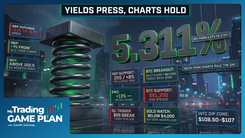
Two key indicators are flashing warning signs that a significant market event could be on the horizon: the 10-Year Treasury yield and the VIX (Volatility Index). The 10-year yield is tracing out a classic bullish consolidation pattern, or bull flag, right up against a major resistance level. A breakout to the upside seems increasingly likely.
Higher yields are poison for a stock market addicted to low rates. They increase the borrowing costs for heavily indebted corporations, put pressure on the housing market, and exacerbate the nation’s fiscal challenges. As Gareth noted, the U.S. is already paying an astonishing $1.2 trillion per year just to service its national debt—a figure that will only climb as rates rise.
Simultaneously, the VIX, often called the market’s “fear gauge,” just hit a low not seen since December 2024. This indicates a dangerous level of complacency.
“When it's low, it tells you people think there's no risk, which is exactly when something can pop up like the yields breaking out, like something from the Supreme Court on tariffs, like Venezuela… the VIX to me is telling me to be on alert.”
Gareth also issued a timely warning about the holiday period. Historically, administrations often release potentially negative or controversial news when the public and the markets are most distracted. The upcoming Christmas and New Year’s holidays provide the perfect cover for such an event, making it a period for heightened vigilance.
A Playbook for Specific Setups
Amidst the macro uncertainty, specific charts are offering clear, actionable setups for disciplined traders. The recent price action in Oracle provides a potential roadmap for a trade in Broadcom. Oracle fell to its gap window and bounced, then sold off more sharply to its gap fill level, where it staged a more significant rally. Broadcom has just completed the first part of this sequence, bouncing from its gap window after a move from a low of $321 USD to $346 USD. Should it follow Oracle’s path, a move down to the gap fill level around $305 USD could present a high-probability swing trade opportunity.
In the commodity space, several key assets are at critical inflection points:
- Gold: After an unconfirmed breakout yesterday, today’s closing price is paramount. A confirmed close above the breakout level could open the door to a move toward $4,800 to $5,000 USD per ounce. Failure to confirm could signal a dangerous fake-out.
- Silver: Silver surged this morning, piercing the top of a parallel channel. The key level to watch is $70. A close above this price could signal further upside into the mid-$70s, while a close below could trigger a pullback to the $65 level.
- Oil: Tipped by Gareth as potentially the best-performing asset of 2026, oil is rallying off technical support. While it has not yet confirmed a major breakout, a successful move higher could target the $78 to $80 USD range in the coming year.
- Natural Gas: Yesterday provided a textbook example of a successful gap fill trade. The price hit the gap fill level from a previous session at around $3.52 and immediately bounced, rallying to a high of $3.82 today—a nearly 10% move in 24 hours.
Conclusion: Navigating the Holiday Lull with Discipline
As we head into the low-volume holiday trading period, the market is sending a series of complex and often contradictory signals. A strong headline GDP number masks deep weakness in the non-AI economy, major indices are facing a lopsided risk-reward profile, and investor complacency is at a yearly extreme just as bond yields threaten to break out.
In this environment, the principles of technical, probability-based analysis are more important than ever. The market is not a monolith; it is a collection of individual setups and opportunities. By focusing on multi-factor support and resistance levels, understanding historical precedents like the dot-com bubble, and maintaining a disciplined risk-reward framework, traders can navigate this challenging landscape. The coming days may be quiet, but the charts suggest that significant volatility could be waiting just around the corner.
Trading involves substantial risk. All content is for educational purposes only and should not be considered financial advice or recommendations to buy or sell any asset. Read full terms of service.