
Trading The Close Market Recap - 02/17/2026: Markets Hold on Warning Track; Gold & Silver Break Structure

In this afternoon's episode of Trading The Close, Pro Trader Drew Dosek at Verified Investing walked viewers through a session defined by resilience, critical technical tests, and the emergence of repetitive chart patterns that every trader should memorize.
The trading session began on what Drew described as a "rocky road," with major indices appearing to be on the verge of significant breakdowns. However, as the day progressed, the markets managed to "save themselves," holding above key trendlines that have defined the recent bullish structure. While the save provides a temporary sigh of relief for bulls, the technical damage occurring under the surface—particularly in consumer non-durables and precious metals—suggests that caution is still warranted.
The Indices: A Precarious Save on the Warning Track
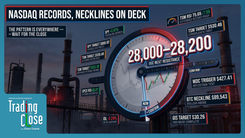
The narrative of the day was the defense of critical support levels. Both the S&P 500 (SPX) and the Nasdaq tested major inclining trendlines that, if broken, could signal a shift in market character.
On the S&P 500, the intraday action told a story of volatility and recovery. The index popped at the open, sold off sharply to tag the trendline, formed a bull flag, and then boosted higher to close the session. While this price action looks constructive in isolation, the context is concerning. The Nasdaq faced a nearly identical situation, bouncing off its own key trendline.
However, Pro Trader Drew issued a crucial warning regarding the frequency of these tests:
"The rapid hits of these trendlines will weaken them very significantly. So if we maintain right here on this trendline, consolidate, we're likely going to then start breaking down and going lower."
This concept is fundamental to technical analysis: support levels are not concrete walls; they are more like glass. The more times price hammers against them, the more likely they are to shatter. Both the S&P 500 and the Nasdaq are currently trading on what Drew calls the "warning track."
In the semiconductor space, the SMH is showing a similar precariousness. The index has been saved by the 50% line of its parallel channel, but price action has been hovering just above this zone for days. Traders must watch the $404.75 level closely tomorrow; a break below this specific price point could trigger the breakdown that the indices have been narrowly avoiding.
Precious Metals: Breaking Structure
While equities managed to hold their ground, the precious metals complex faced significant selling pressure, resulting in technical damage that alters the near-term outlook.
Gold: The 50% Breach
Gold has broken a key structural level: the 50% line of its parallel channel. In technical analysis, the midline of a channel often acts as a pivot for trend strength. Trading above it implies aggressive bullishness; breaking below it suggests a rotation toward the bottom of the channel.
With this breakdown, the probabilities now favor a move down to the bottom of the parallel channel at approximately $4,715. While a bounce is possible there, Drew highlighted a more significant historical level:
"This area is going to be the most solid level of support at $4,400, but there should be some intermediate levels of support… should we see continued selling pressure arise in gold."
This $4,400 level corresponds to a major pivot high from October 20th, illustrating the principle of "polarity"—where former resistance becomes future support.
Silver: A Sharp Reversal
Silver experienced a more violent move, dropping 4.9% in a single session. Previously trading near $72, it fell toward the $73.54 area (noting the volatility in the transcript's pricing context). The chart had been showing a bullish consolidation, but a massive red candle on Thursday altered that pattern entirely.
The metal is now consolidating near the lows of that breakdown candle. In technical analysis, consolidation at the bottom of a large red candle is a bearish continuation signal, often referred to as a "bear flag" or "falling three methods." Drew’s analysis points to a target derived from a longer-term trendline originating in August 2025, which suggests price could fall to just under $60 if the selling pressure accelerates before the end of the month.
Natural Gas: The Importance of Historical Pivots
The energy sector also saw weakness, with Natural Gas down 2.08%. The commodity broke an inclining parallel channel—a move it has made before only to reverse—but this specific break appears to have more "intention."
The immediate support lies at $2.71, defined by recent low pivots. However, Drew warned that this level has been tested multiple times (August, January), making it susceptible to a break. If $2.71 fails, the next major buy zone is $2.40.
This $2.40 level is a textbook example of market memory. It represents a zone of heavy consolidation and pivots dating back to August 2024. When identifying support, looking left on the chart to find where significant volume and decision-making occurred in the past is essential for accurate target setting.
Educational Spotlight: The "Scene of the Crime" Pattern
One of the most valuable segments of today's show was the deep dive into a specific, repeatable chart pattern: the "Retest of the Scene of the Crime."
This pattern occurs when a stock breaks a long-standing trendline, drops, and then rallies back up to touch the underside of that broken trendline. This retest often acts as a "kiss of death," confirming the breakdown before sending the stock lower.
"That's how my mind goes through the charts. I see a break. Okay, now that means this. Now we break through back to the other side. Okay, now we need to confirm for it to mean X."
CrowdStrike and AMD: Mirror Images
Both CrowdStrike and AMD are currently exhibiting this exact pattern.
- CrowdStrike: Broke an inclining parallel channel dating back to August 2024. It retraced to the underside of the parallel and was rejected. The rejection confirms the new downtrend, with support now sitting at $355.54.
- AMD: Displayed the same behavior relative to a trendline from April 2025. After plunging on earnings, it rallied back to the trendline and was rejected. While it found intraday support today under $195, the structural damage remains.
The psychology behind this pattern is powerful. Investors who bought the stock while it was above the trendline are now "trapped" underwater. When the price rallies back to their entry point (the trendline), they sell to get out at breakeven. Simultaneously, short sellers recognize the broken support as new resistance and enter positions. This dual supply of selling pressure creates the rejection.
Drew noted that fundamental narratives often align with these technical breaks. For CrowdStrike, fears of AI bots and agents replacing software functionality are driving the selling pressure. For the pattern to be negated, price would need to reclaim the parallel channel—until then, the probabilities favor the downside.
Consumer Non-Durables: Warnings and Head & Shoulders
The consumer non-durable goods sector took a significant hit today, led by a revised outlook from General Mills. This move highlights how technical patterns often precede fundamental news.
General Mills had been forming a bull flag, but the pattern failed. A failed bullish pattern is often a potent bearish signal because it traps aggressive buyers who anticipated a breakout. The stock is now at a critical juncture. Bears need to see a close below the candle low of $43.72 to confirm a move to $42.63.
However, the weekly chart reveals a much more ominous setup: a massive Head and Shoulders pattern.
"We have a left shoulder, a massive head, and a right shoulder… We can see clearly, price broke, and just like on AMD… it came right back up to this trend line, sold off some more."
The Head and Shoulders is a classic reversal pattern. By measuring the distance from the "head" to the "neckline" and projecting that downward from the break, Drew calculated a measured move target of $30.26. This implies that General Mills could be facing a prolonged period of pain, despite any short-term bounces.
In contrast, Kraft Heinz, which fell in sympathy, is testing a different structure. It retraced to the "scene of the crime" of a breakout, not a breakdown. It is testing the top of a declining trendline it previously broke above. If it holds the $24.39 area, it remains a bullish retest, proving that context is everything when analyzing similar moves across different charts.
Wingstop: The Earnings Wildcard
Wingstop (WING) surged over 13% ahead of its earnings release, a move that Drew views with caution. The stock has pushed back above the 50% line of its declining parallel channel.
If the earnings are positive, immediate resistance stands at $261.30. However, if the move was a "buy the rumor, sell the news" event, or if earnings disappoint, the stock could revisit support at $206. This setup serves as a reminder that earnings are binary events that can disrupt technical patterns, requiring traders to remain agile.
Amazon: The Tale of Two Timeframes
Finally, the analysis of Amazon provided a masterclass in "Timeframe Continuity"—or the lack thereof. Traders often make the mistake of looking at only one timeframe, missing the broader picture.
The Daily Chart: Amazon looks ripe for a bounce. The RSI is at 26.68, indicating oversold conditions. A bounce to the bottom of the parallel channel at $192.77 or even the resistance at $209.99 is statistically probable.
The Weekly Chart: The picture is far darker. The weekly RSI is not oversold, suggesting plenty of room for further downside. Furthermore, the 200-week Simple Moving Average (SMA) is creeping up toward $170.
"Investors are getting a little bit more worried about when AI is actually going to start returning their investment. And if this is just going to be another big money pit, we'll come to find that out in the coming years."
This divergence between daily and weekly timeframes suggests that while a short-term trade might exist to the upside (the daily bounce), the longer-term trend remains under pressure due to fundamental concerns over Amazon's $200 billion AI investment. Smart traders might use the daily bounce to exit long positions or initiate short positions in alignment with the weekly trend.
Conclusion: Discipline in a Fragile Market
Today's market action was a lesson in the fragility of support. While the indices "saved themselves" for now, the weakening of trendlines through repeated testing, combined with breakdowns in metals and consumer staples, paints a complex picture.
The recurrence of the "retest of the scene of the crime" pattern across multiple sectors—from Tech (AMD) to Staples (General Mills)—reinforces the value of technical analysis. These patterns repeat because human psychology repeats. By memorizing these setups and understanding the "degrees of probability" they represent, traders can navigate the volatility with logic rather than emotion.
As we look ahead to the release of FOMC minutes and further inflation data later this week, maintaining strict discipline around these technical levels will be paramount. The warning track is not a place to be complacent.
Trading involves substantial risk. All content is for educational purposes only and should not be considered financial advice or recommendations to buy or sell any asset. Read full terms of service.