
Trading The Close Market Recap - 03/16/2026: Triple Witching Relief Rally, 10-Year Yield Pullback & Oil Volatility

The markets staged a minor relief rally today, providing a brief respite from the heavy selling pressure that has dominated recent sessions. However, beneath the surface of this seemingly straightforward bounce lies a complex web of structural market mechanics, algorithmic triggers, and geopolitical crosscurrents. In this afternoon's Trading The Close episode, Verified Pro Trader Drew Dosek at VerifiedInvesting.com broke down the critical technical levels and macroeconomic forces driving current price action.
For traders and investors trying to navigate this volatility, understanding the "why" behind today's moves is just as important as knowing the key levels. From the hidden mechanics of options expiration to crucial divergences in commodity markets, today's analysis provides a comprehensive roadmap for the days ahead.
The Mechanics of Triple Witching
One of the most critical factors influencing market behavior this week isn't necessarily fundamental news or earnings—it's market structure. We are currently entering a "triple witching" options expiration week, a period characterized by the simultaneous expiration of stock options, stock index futures, and stock index options.
Following a month where a massive volume of put options were sold, the market was structurally primed for a bounce. Drew highlighted the reality of how large institutions manage these massive options expirations:
"…that is definitely a manipulative game that the institutions play to ensure that they sell the contracts so that they make money, and all of the people that bought them have them expire worthless."
This phenomenon, often referred to by professionals as "pinning" or "pegging," occurs when market makers and large institutions hedge their massive options books. They utilize algorithmic programs to drive underlying stock and index prices toward specific strike prices where the maximum number of options will expire worthless—a concept known as "max pain." Because of this dynamic, the current relief rally should be viewed through a lens of healthy skepticism. While the bounce is real, its longevity remains highly questionable once Friday's expiration passes.
Index Technicals: Navigating the Relief Rally
The broader market indices reflected this relief rally, but their technical postures remain precarious.
S&P 500 and SPY: Approaching the Gap
The S&P 500 pushed up 1.02% today, a solid move, but one that remained entirely within the range of Friday's price action. For the SPY ETF, the immediate upside target is a clear gap fill at 676.33. Gap fills act as powerful magnets for price action, representing areas where liquidity was previously bypassed during a sudden move.
Beyond the gap fill, the ultimate near-term bullish scenario requires tagging an inclining trend line at 679.82. If the SPY can secure a daily close above this 679.82 level, it could negate the current negative pattern and transition the market back into a phase of healthy consolidation. Until then, traders should treat this as a near-term bounce susceptible to renewed selling pressure later in the week.
NASDAQ: The Line in the Sand
The tech-heavy NASDAQ faces a more challenging technical setup. After comfortably closing beneath its inclining trend line last Thursday and Friday, today's action merely served as a retest of that breakdown level.
To shift the probabilities back toward a bullish posture, the NASDAQ must conquer a critical level tomorrow: 24,753 points. However, it's not just a single line; a declining trend line also sits just above, creating a confluence of resistance. Unless the index manages a powerful gap-up open, traders should anticipate choppy consolidation rather than a smooth breakout.
Semiconductors and Small Caps
The semiconductor sector, tracked by the SMH, led the indices today with a 1.7% gain. Despite the strength, it remains trapped in the lower range of an inclining parallel channel. Support sits firmly at $386.74, followed by an inclining trend line at $379.25. Upside progress is currently capped by heavy resistance at $407.40.
Meanwhile, the Russell 2000 (IWM) gained 0.94%, but the overarching technical pattern remains ominous. The chart displays a textbook head and shoulders pattern—a left shoulder, a head, and a right shoulder. This formation is a classic indicator of buyer exhaustion, and it currently points to a downside target of 241.78 for the IWM.
The 10-Year Yield: The Algorithmic Trigger
Perhaps the most significant macro driver of today's equity bounce was the cooling of the 10-year Treasury yield. The relationship between yields and equities is foundational; as yields rise, the discount rate applied to future corporate earnings increases, making stocks—particularly growth stocks—less attractive.
Drew emphasized how rapid yield spikes trigger automated selling:
"…especially if it rises very quickly and hits significant threshold levels, like 4.5%, we could have many more algos start [to] trigger selling into the market, selling equities with the high and quick move on the 10-year yield."
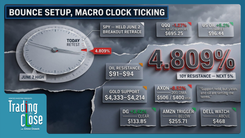
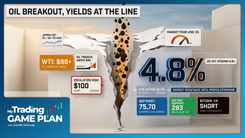
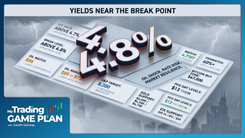
Today, the 10-year yield pulled back, stopping perfectly at a declining trend line that previously acted as resistance before last week's breakout. This retest of the breakout level is textbook technical behavior. The critical question now is whether the yield will consolidate here or stage a "rocket ship bounce" higher. Given the current geopolitical uncertainty, every tick of the 10-year yield will directly impact market liquidity and the broader risk-on/risk-off appetite.
Commodities: Geopolitics and Technical Divergences
Commodity markets are currently serving as a real-time barometer for global geopolitical tensions, presenting massive volatility and distinct technical setups.
U.S. Oil's Wild Ride
U.S. Oil provided the most dramatic price action of the session. Driven by geopolitical headlines, oil opened Sunday night above $100, surging to a peak of $102.44. However, it subsequently fell off a cliff, trading all the way down to $93.81.
While $93.81 remains elevated compared to pre-conflict levels, this sharp rejection off the highs provided massive relief to equity markets. High oil prices act as a regressive tax on consumers and compress corporate profit margins. Day traders and swing traders must keep a close eye on oil; an uptick will likely pressure equities, while continued down-ticking will provide a tailwind for risk-on assets.
Gold and Silver: Hanging by a Thread
Precious metals are flashing warning signs. Gold traded essentially flat today (-0.04%), but its saving grace was managing to close within the range of the critical March 3rd candle. A close beneath that candle's low would dramatically increase the probability of a drop to the bottom of its parallel channel at $4,865.
Silver is painting an even more bearish picture. Like gold, it is contained within its March 3rd red candle, but it is currently carving out a classic bear flag pattern. This consolidation near the bottom of its recent range implies a high probability of further downside, with a clear technical target of $63.73—a level that perfectly aligns with the bottom of the February 6th support candle.
Natural Gas: The Bearish Rejection
Despite global tensions that fundamentally should support energy prices, Natural Gas continues to struggle technically. After a rug-pull late last week, price action remains trapped in bearish consolidation. The chart is screaming for a move down to the $2.71 target to finally test major support. To the upside, the inclining parallel channel presents formidable resistance at $3.15. Only an accelerating move through $3.15 would open the door to the higher target of $3.58.
Bitcoin's Critical Juncture
Cryptocurrency markets are at a massive technical inflection point. Bitcoin has been repeatedly testing a major resistance level, but failing to secure the necessary daily closes to confirm a breakout.
"I've clearly got displayed here a line to beat $73,173.96. That's the top value of this big red candle."
Bitcoin has pierced $73,173.96 multiple times, but every attempt has been rejected by the daily close. To trigger a near-term bullish bounce, Bitcoin needs a daily close above this line, followed by a confirming push higher the next day. If successful, the first upside target is $80,500. Beyond that lies the ultimate near-term bullish destination: the neckline of a massive head and shoulders pattern at $84,603.
However, traders must remain objective. The larger-term pattern on Bitcoin is still a bear flag. If it fails to break above these resistance levels, the overarching probabilities dictate a devastating move back down to sub-$40,000.
Tech and AI: Massive Deals and Extended Charts
Individual tech names provided some of the most explosive moves of the day, driven by massive corporate investments and AI infrastructure build-outs.
NBIS and META: The $27 Billion Catalyst
NBIS gapped up and surged nearly 15% today following news of a staggering $27 billion deal with Meta to build out AI data centers. This comes hot on the heels of a recent $2 billion investment into NBIS by Nvidia.
Technically, NBIS had been forming a tight bear flag consolidation. Today's massive 33% to 34% move off the recent lows has pierced the top of that flag, but the pattern isn't fully negated yet. To officially break the bear flag, NBIS needs a daily close above the flagpole high of $134.93. If it achieves this, immediate resistance sits at $135, followed by the double-top all-time high at $141.10. However, traders should watch for a potential pierce of these levels followed by healthy consolidation.
Meta also caught a bid on the news, rising 2.24%. The stock found perfect support on an inclining trend line drawn from previous pivot lows—acting like a trampoline for price action. As Meta moves higher, it faces a declining trend line resistance at $643. A close above $643 opens the door to $670.51. However, the larger pattern remains a bear flag, which implies an eventual downside target of $600.38 at the bottom of its long-term parallel channel.
SNDK: The Parabolic Run
SNDK has been on an absolute tear, marching from roughly $515 on March 9th to over $700 in just six trading days. The stock has now reached a critical double-top all-time high resistance at $725.
Drawing trend lines from the January 26th lows to recent pivots reveals a precise roadmap of overhead supply. Today, SNDK pushed straight into trend line resistance, consolidated, and experienced a late-day rug pull on the 10-minute timeframe. For tomorrow, traders should watch the $725 level, followed by the next major trend line resistance at $755. Given the velocity of this move and the time count scenario, SNDK is highly likely to stall and catch its breath in this zone.
Earnings and Breakouts: Dollar Tree and Kava
While macro forces dominate the headlines, individual stock setups continue to provide high-probability trading opportunities.
Dollar Tree (DLTR) reported earnings today, beating EPS estimates by 1% but missing revenue expectations by a slight 0.16%. Despite the mixed fundamental picture, the technical reaction was incredibly bullish. The stock managed to close above a massive declining trend line that dates all the way back to July 2022. This three-to-four-year trend line breakout is highly significant. If DLTR can secure another close above today's candle, the $113.21 level becomes a strong buy-in support zone, with upside targets at $119 and eventually $126.99.
Similarly, Cava is presenting a textbook breakout scenario. The stock has been fighting a trend line originating in November 2023 that has effectively cut the chart's price action in half. Today, Cava managed to close above this line by a hair. If we see continuation tomorrow, this breakout scenario targets $92.70. Any pullbacks to the trend line at $87.34 should be viewed as high-probability buying opportunities.
Conclusion: Patience Ahead of the Fed
While the technical setups across indices, commodities, and individual stocks are compelling, traders must exercise extreme discipline this week. The Federal Reserve's FOMC meeting kicks off on Tuesday, culminating in Jerome Powell's highly anticipated press conference and the release of the meeting minutes on Wednesday.
Historically, market volume dries up and price action becomes erratic in the days leading up to a Fed decision, as large institutions step to the sidelines to await clarity on interest rates and monetary policy. Attempting to front-run the Fed is a low-probability game.
As always, successful trading is about removing emotion, relying on logic, and executing based on strict technical probabilities. By mapping out these critical levels in advance—from the SPY's 676.33 gap fill to Bitcoin's $73,173.96 resistance—traders can prepare to react objectively to whatever volatility the triple witching expiration and the FOMC meeting bring to the table.
Trading involves substantial risk. All content is for educational purposes only and should not be considered financial advice or recommendations to buy or sell any asset. Read full terms of service.