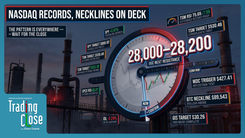

Trading The Close Market Recap - 04/01/2026: Low-Volume Rally: Oil, Yields & AI Stocks Signal Caution

The markets attempted to build on yesterday's monumental bounce, pushing higher across major indices, but a critical component was glaringly absent: volume. As geopolitical tensions continue to dominate headlines with conflicting reports regarding Middle East negotiations, retail traders are left wondering if this rally has legs or if it's merely a low-volume trap. In today's Trading The Close Market, Pro Trader Drew Dosek at VerifiedInvesting.com broke down the price action, revealing why the current market structure demands caution and where the true barometers of market sentiment currently lie.
The Volume Void: Reading Institutional Footprints
One of the most foundational principles of technical analysis is that volume precedes price. Volume is the footprint of institutional investors; it tells us whether the "smart money" is actively participating in a move or sitting on the sidelines. Today's market action provided a textbook example of a rally lacking institutional sponsorship.
"…the truth all lies in current price action and there's no conviction because there's uncertainty," Drew explained, highlighting the stark contrast in trading activity.
By 1:00 PM today, the S&P 500 had only traded about 40 to 50 million shares, eventually pushing in an additional 20 to 30 million shares by the close. When compared to yesterday's 152 million shares, the drop-off is severe. To truly understand what a solid market bottom looks like, we must look at historical precedents. During the sharp decline last April, the market put in a definitive bottom characterized by massive accumulation days. We saw consecutive volume prints of 217 million, 256 million, 165 million, 241 million, and 162 million shares. That is what institutional conviction looks like.
Currently, the S&P 500, despite closing up 0.75%, is floating upward on anemic volume toward a key resistance level at 665.01. Furthermore, the daily candle developed a pronounced wick at the top, a technical formation that has historically foreshadowed further downside. The 10-minute chart corroborated this weakness, showing a strong morning push that quickly reversed, bringing price right back to the opening range. Without volume, breakouts are suspect, and rallies are vulnerable to sudden reversals.
Intermarket Dynamics: The Oil Barometer and Treasury Yields
When geopolitical uncertainty strikes, the news cycle becomes a chaotic echo chamber of conflicting reports. Today, with the United States claiming negotiations are ongoing in the Middle East while Iran states they are not, traders can easily fall victim to headline risk. However, Drew offered a masterclass in filtering out the noise by focusing on the ultimate truth-teller: Crude Oil.
"…no matter what's going on, no matter what the news is talking about with this development or that development, guys, just turn your attention to oil. The price in oil will guide you as to where the rest of the markets are going," he noted.
US Oil is currently trading underneath the psychological century mark at $99.33, having perfectly executed a temporary head and shoulders pattern identified in yesterday's show. After the neckline broke on Tuesday at 12:00 PM, oil cascaded downward, completing 80% to 90% of its measured move before catching support and bouncing. It is now capped by a near-term trendline at $100.67.
The relationship here is inverse and highly correlated: if oil breaks its $103.15 resistance and surges, equities will likely face intense selling pressure. Conversely, if oil breaks its current support at $98.11, the next target becomes the bottom of the parallel channel at $92.80, which would provide a massive tailwind for the broader stock market.
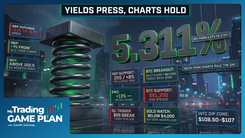
Similarly, the 10-year Treasury yield remains a critical headwind. While yields pulled back nicely today, they failed to close under the pivotal 4.3% threshold. For the equity markets to sustain a meaningful upward trajectory, the 10-year yield needs to break and remain beneath 4.309%. Elevated yields force institutions to revalue equities, particularly long-duration growth stocks, making this a must-watch level for the remainder of the week.
Tech and Semiconductors: Testing Critical Boundaries
The technology sector, led by semiconductors, has been the primary engine of the bull market. The SMH (Semiconductor ETF) gained 2.24% today, piercing a long-term inclining parallel channel resistance. However, the true test comes tomorrow. The SMH must secure a close back inside that parallel channel at $395.85 to maintain its bullish posture. Failure to do so could result in a retest of the lower trendline at $381.14.
The NASDAQ 100 painted a similar picture of hesitation. The index pierced its resistance level at 24,117 but failed to hold the gains, finishing the day comfortably underneath at 24,019. While this keeps the index inside its parallel channel, a failure to break resistance could turn this level into a formidable ceiling, with downside support waiting at 23,823.
The AI Momentum Trade: Warning Signs in Memory Stocks
Perhaps the most crucial technical developments are occurring in the memory and AI data center space. SNDK has been the number one gainer in the S&P 500 this year, acting as a barometer for risk appetite. While it confirmed support at a declining trendline at $613 and the bottom of a parallel channel at $636.51, a massive, ominous macro pattern is developing: a head and shoulders top.
The neckline for this potential reversal pattern sits at an inclining trendline of $587.20. If SNDK breaks this line in the sand, the measured move could send the stock sub-$400. This would suck a tremendous amount of momentum out of the entire AI sector. To negate this bearish setup, SNDK must break above the "head" of the pattern at the March 20th high of $777.60.
Sister stocks in the memory space are showing similar exhaustion. WDC is forming a nearly identical head and shoulders pattern, facing heavy resistance at the 50% area of its parallel channel around $310, with a neckline at $257.49. Meanwhile, MU bounced perfectly off its inclining parallel channel support, piercing resistance at $372.55. However, MU faces a gauntlet of triple resistance ahead at $404.82, $410.28, and the 50% parallel line at $418. The probability of MU marching straight through this dense resistance zone without consolidation or a pullback is statistically low.
The Psychology of Patience: The Wingstop Setup
While momentum stocks show signs of exhaustion, professional traders are always scanning the market for extreme dislocations. Wingstop (WING) provides a perfect case study in waiting for high-probability, oversold setups.
Following a brutal 50% decline from $302 down to $144, Wingstop has cascaded into a highly compelling technical zone. The stock has printed a series of downward moves followed by bear flags, systematically shaking out weak hands. Now, it approaches the bottom of a parallel channel at $141.90, a level that aligns with historical pivots and extreme oversold RSI readings ($21.30 on the daily and $29.23 on the weekly).
"Whenever you see a chart like this and you see a parallel with that's honored support levels in the past, and then you have price plunging down into that support level, it's getting oversold near term, it's getting into a technical support — guys, it's a reason to put your finger on the trigger and buy that stock right here," Pro Trader Drew emphasized.
This setup highlights the psychological discipline required for successful trading. Amateurs often chase stocks making new all-time highs, buying into resistance. Professionals wait for fundamentally sound companies (like Wingstop, which historically maintains consumer demand regardless of broader economic difficulties) to plunge into mathematically significant support levels.
Risk management, however, remains paramount. If the $141.90 support fails, the next significant floor is down at $110.50. But with conservative bounce targets at $179.19 and aggressive targets just above $200, the risk-to-reward ratio heavily favors the prepared trader.
Corporate Catalysts: Intel and the Aerospace Sector
Individual corporate catalysts also drove significant price action today. Intel (INTC) surged 8.84% following news that it is buying back its Apollo stake in Ireland for $14.2 billion (utilizing $6.5 billion in debt and the remainder in cash).
From a technical perspective, Intel is running directly into an inclining trendline resistance dating back to July 2024 at $49.08. If it can clear this hurdle and surpass the weekly topping tail from January 20th, the stock has room to run toward $57 and $62. The ultimate macro destination appears to be a declining trendline from January 2020, sitting right around $65. However, after such a sharp move, bullish consolidation is the highest probability outcome before the next leg up.
In the aerospace sector, anticipation of tonight's Artemis launch from Florida brought attention to key contractors. GE pushed up 3.14%, hitting support at $276.24 and bouncing directly into the 50% area of its parallel channel at $296.60. With major resistance looming at $312 and the stock having previously broken down from a long-term trendline, the near-term upside appears limited.
Honeywell (HON), which holds multiple contracts through Artemis 9, presents a more complex technical picture. After a massive surge from $194 to $248 in January, the stock has been trading sideways for the past five sessions with its RSI resting near 50. To regain its bullish momentum and re-attack the $247 consolidation zone, Honeywell must secure a daily close above the high of the March 20th red candle at $229.50. If it fails, probabilities dictate a pullback to the inclining trendline at $212.18, with major historical pivot support waiting at $210.22.
Precious Metals and Crypto: Diverging Paths
The alternative asset space continues to show fascinating divergences. Gold surged 1.98% today, blowing through resistance to turn $4,603 into a rock-solid support level. The precious metal is now targeting the upper bound of its parallel channel at $5,000 per ounce.
Silver, conversely, took the day off. It remains capped by a stubborn resistance level at $75.33, displaying a notably more bearish posture than gold. This divergence between the two metals is worth monitoring, as silver's failure to confirm gold's breakout often signals underlying market hesitations.
In the cryptocurrency markets, Bitcoin remains flat, down 0.27% on the day. The macro picture remains concerning, with a large head and shoulders pattern pointing to a measured move target of $37,000. Before that selling pressure can truly accelerate, however, Bitcoin must break its parallel support at $61,277.
Conclusion: Trading Probabilities, Not Predictions
Today's market action perfectly encapsulates why professional traders rely on technical levels rather than emotional reactions to news headlines. The S&P 500's low-volume push higher, the precise technical rejections in the NASDAQ 100 and IWM (which tagged resistance at $250.25 before pulling back), and the ominous patterns developing in market-leading AI stocks all point to a market that requires extreme caution and selective stock picking.
By focusing on multi-factor technical support levels—like the compelling setup in Wingstop—and using intermarket barometers like US Oil and the 10-year Treasury yield to gauge true market sentiment, traders can strip away the noise and operate purely on probabilities.
As the Verified Investing network celebrates its monumental milestone of reaching 100,000 subscribers and launches the new Verified Investing Extra channel, the core mission remains unchanged: empowering retail investors with the institutional-grade technical analysis required to navigate these complex markets. By maintaining discipline, managing risk, and letting the charts dictate the narrative, traders can position themselves for success regardless of what the headlines bring tomorrow.
Trading involves substantial risk. All content is for educational purposes only and should not be considered financial advice or recommendations to buy or sell any asset. Read full terms of service.