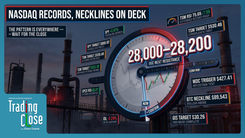

Trading The Close Market Recap - 04/29/2026: Rising Yields Put Tech at Risk as Mega-Cap Earnings Ignite Volatility

Right now the macroeconomic landscape is being driven by a complicated mix of monetary policy, geopolitical tension, and a barrage of corporate earnings. While the broader markets digest the Federal Reserve’s latest moves and ongoing conflicts in the Middle East, the real story is unfolding beneath the surface in individual stock charts and sector technicals.
In this afternoon's Trading The Close, Pro Trader Drew Dosek at Verified Investing broke down the critical technical levels across indices, commodities, and the mega-cap tech giants reporting earnings this week. Today’s article expands on these key themes, offering a deeper dive into the technical structures and psychological drivers currently dictating market direction.
The Macro Backdrop: FOMC Predictability and the Yield Threat
Market participants went into the latest Federal Open Market Committee (FOMC) meeting with clear expectations, and the central bank delivered exactly what was priced in.
"The FOMC yesterday was 100% lock and guarantee with no rate cut. So we knew what to anticipate," Drew noted.
While the dialogue revealed internal dissent among governors—with some advocating for cuts and others pushing to hold steady—the lack of immediate policy change meant the market's attention quickly pivoted to the bond market. Specifically, the 10-year Treasury yield is flashing warning signs that equity bulls cannot afford to ignore.
The 10-year yield pushed up significantly, crossing above the 4.4% threshold. From a technical perspective, the yield has formed a textbook bull flag pattern. This formation consists of a sharp, aggressive move higher (the flagpole) followed by a period of sideways consolidation (the flag). As the yield begins to break to the upside of this consolidation, it threatens to push higher than its recent pivot high.
If this breakout is confirmed, the measured move target for the 10-year yield sits at 4.58%. A sustained move toward this level would dramatically increase borrowing costs for corporations, compressing profit margins and creating a formidable headwind for equity valuations, particularly in growth and technology sectors.
Index Technicals: Volume, Price Action, and the Importance of the Close
The broader equity indices are currently exhibiting a lack of conviction, characterized by anemic volume and sideways price action. The S&P 500 finished the day essentially flat, down a mere 0.02%. While the index has printed wicks on the bottom of its recent daily candles—suggesting intraday buyers are stepping in—the volume tells a different story. With only about 39 million shares traded, market participation is exceptionally low.
For the S&P 500 proxy (SPY), near-term support rests on an inclining trendline at 706.57, while upside resistance at the top of its parallel channel sits at 713.45.
The NASDAQ (IXIC) mirrors this indecision. After kissing the top end of its parallel channel, the tech-heavy index chopped sideways to close up just 0.04%. However, with several mega-cap tech stocks taking a hit in after-hours trading, downward pressure on the NASDAQ is highly probable in the coming sessions.
The Philosophy of "Trading The Close"
The Russell 2000 (IWM) provided a perfect case study for one of the most critical concepts in technical analysis: the closing price. The small-cap index had a notably weaker day, dropping 0.67%, largely pressured by the rising 10-year yield. However, the exact level where it finished the session is what matters most to professional traders.
"Where price closes helps us determine whether or not our patterns are valid or not," Drew explained.
During the session, IWM dropped to a low of 271.95, dipping dangerously close to breaking its consolidation range. But by the closing bell, buyers pushed it back to 272.08. Because the close remained within the range of the previous down wick, the near-term pattern is still classified as consolidation rather than a breakdown.
"Whenever we have a close underneath the low of a consolidation, probabilities start shifting for more downside," Drew emphasized. If IWM fails to hold this consolidation and closes lower in subsequent sessions, the next minor support level to watch is 268.44.
Semiconductors: Momentum vs. Overbought Conditions
The semiconductor sector continues to be a battleground between intense momentum and overextended technicals. The SMH ETF posted a strong 1.7% gain, bouncing away from the top end of a parallel channel it recently broke out of.
However, breakouts from inclining parallel channels are notoriously difficult to sustain. For the price to maintain its trajectory above an upward-sloping channel, the asset must continuously accelerate its upward march. Meanwhile, the RSI (Relative Strength Index) for SMH is flashing overbought signals. While momentum can keep an asset overbought for extended periods, this technical friction suggests the rally may soon stall. The critical area to watch for a potential breach is $485.69.
The Earnings Paradox: When Stellar Results Trigger Selloffs
Earnings season is the ultimate test of market psychology. Often, the reaction to an earnings report is far more revealing than the fundamental data itself. This dynamic was on full display with memory storage giant STX.
STX delivered a phenomenal quarter, beating earnings per share estimates by 16% and revenue by 5%, accompanied by stellar forward guidance. Yet, after gapping up and stalling at $697, the stock faced relentless selling pressure throughout the trading day.
"If you were just to flip over your brokerage, not look at the charts and you had STX and you say, hey, it's up 11%, that's a fantastic day, but what happened internally today really doesn't paint that story," Drew pointed out.
Despite closing up 11%, the intraday chart revealed that investors used the gap-up as a liquidity event to aggressively take profits. When a stock reports flawless numbers and raises guidance, yet institutions hit the sell button all day, it signals underlying exhaustion in the trend. If STX continues to break down, it risks falling through minor support at $623.02, with a deeper gap-fill target looming at $580.
Sympathy Plays and Topping Tails
This profit-taking behavior spilled over into STX's peer, WDC. WDC pushed higher in sympathy but ultimately reversed, forming a massive daily topping tail ahead of its own earnings report.
A topping tail is a powerful reversal candlestick. It shows that buyers aggressively pushed the price higher intraday, only to be completely overwhelmed by sellers who drove the price back down by the close. Furthermore, this reversal occurred exactly at the measured move target of a weekly bull flag pattern. Technical traders recognize that when a measured move is tagged, it is a high-probability location to lock in profits. With this technical completion and a topping tail in place, WDC is likely targeting the top of its parallel channel at $391, just under the psychological $400 mark.
The Guidance Penalty
While STX sold off despite great guidance, SOFI demonstrated what happens when guidance actually disappoints. SOFI beat both EPS and revenue expectations but issued weaker guidance for the second quarter. The market's reaction was swift and punitive.
As we move deeper into the year, forward guidance is heavily outweighing backward-looking performance. SOFI is now threatening to break below key low pivots sub-$15. If that level fails, the next major structural support aligns with an inclining parallel channel bottom at $12.92.
Similarly, HOOD suffered a massive 13.24% drop after missing on both earnings and revenue, plagued by weakness in crypto and stock trading volumes. The stock must now defend a critical inclining trendline at $66.42. If this major support breaks, it completely invalidates the prior bullish structure, opening the trapdoor to $56.24.
Mega-Cap Tech: After-Hours Volatility
The after-hours session brought a wave of volatility as the market's heaviest hitters reported their quarterly results, setting the stage for significant index movement.
Microsoft (MSFT): The software giant experienced wild after-hours swings, surging to $445 before plunging to $407, ultimately holding a near-term downside bias. Traders must watch the declining trendline at $410.95. If that breaks, the bottom of its parallel channel at $403.84 becomes the next magnet for price.
Amazon (AMZN): After popping initially, Amazon plunged to $245.15 before settling around $258.60, retesting its previous all-time highs. The critical line in the sand to maintain its bullish posture is an inclining trendline at $253.65.
Meta Platforms (META): Meta took a sharp dive following its report, plunging beneath its inclining trendline. The stock is now testing a crucial gap-fill area at $612.42. If this level fails to hold the after-hours pressure, the bottom of its parallel channel sits just below at $607.58, presenting a highly compelling zone for potential day-trade setups.
Alphabet (GOOGL): Bucking the broader tech trend, Google maintained an elevated status post-earnings, trading around $367.55. The stock faces near-term resistance at an inclining parallel top of $373.93, which closely aligns with the major psychological barrier of $375.
Commodities and Crypto: Critical Junctures
The commodity markets are currently flashing distinct technical patterns that require strict discipline to navigate.
Precious Metals: The Value of Pattern Recognition
Gold is currently exhibiting a curling-over action, breaking underneath minor support at $4,588.
"Patterns repeat over and over, which is why technical analysis is so valuable to have in your tool box when you are trading," Drew observed, noting the similarity to previous price action. If gold fails to hold its next minor consolidation support at $4,494, the chart opens up for a significant drop to sub-$4,200 levels.
Silver is following gold's bearish lead, dropping to $71.34 and distancing itself from previous support. With two consecutive down days, previous support has flipped to resistance at $75.33. The shifting probabilities point to further downside, with an inclining trendline target of $67.78.
Energy: Oil's Resistance and Natural Gas Support Degradation
US Oil is fighting through a thicket of overhead supply. After rocketing to resistance at $104.34, price was rejected, retraced, and then surged to the next resistance at $107.48. What followed was a grueling consolidation period from 11:50 a.m. to 3:20 p.m. before it could gather the strength to push higher.
Oil is currently attempting to reclaim a parallel channel. If it succeeds, the next upside targets are $111.71 and a trendline at $117. However, traders must respect the high of a recent massive red distribution candle at $109.19, which could act as a brick wall for price action. Monitoring oil is vital for equity traders, as sustained high energy prices directly erode corporate margins via elevated transportation and distribution costs.
Meanwhile, Natural Gas continues to test support at $2.71. In technical analysis, support is like ice on a frozen pond—the more times you jump on it, the weaker it gets. Continued testing of this level increases the probability of a structural break, which would send Natural Gas tumbling toward the next demand zone at $2.41.
Bitcoin's Line in the Sand
Bitcoin experienced a volatile session, dropping roughly 1% after failing to reclaim a bullish consolidation zone. Despite the intraday weakness, the cryptocurrency is defending its most critical technical level. For bulls, the absolute line in the sand is a daily close above $73,173.96. As long as price remains above this threshold, the broader uptrend remains intact, with upside targets at the $80,700 pivot and an inclining trendline at $85,390.
The Discipline of Risk Management
When navigating highly volatile assets, risk management supersedes all other considerations. This was highlighted in the analysis of viewer-requested stocks USAR and CRML.
USAR, a highly volatile rare earth stock prone to meme-like price action, recently broke out of a declining trendline but is now consolidating dangerously close to that same line at $21.20. If it breaks, a gap fill at $20 provides minor support, but a deeper plunge to 18.15 is on the table. CRML paints a similar picture, failing to confirm a breakout and requiring a push past $14.20 to validate any bullish thesis, while risking a drop to $9.50.
The lesson here is profound: when trading assets with massive intraday ranges, position sizing must be kept exceptionally light. Professional traders don't marry these types of stocks; they play the technical levels, take their profits quickly, and move on.
Conclusion: Clarity Before Complexity
As the market digests this week's onslaught of mega-cap earnings, shifting bond yields, and geopolitical headlines, the noise can easily overwhelm the average investor. The divergent reactions to earnings—where stellar results are sold and weak guidance is punished—prove that trading based on fundamental headlines alone is a losing game.
Success in this environment requires stripping away the speculation and focusing purely on structure. By identifying high-probability patterns, respecting critical support and resistance levels, and waiting for the closing bell to validate technical formations, traders can replace emotional guesswork with logical, probability-based execution. As the charts continue to develop in the wake of this pivotal week, maintaining this disciplined, level-to-level approach will be the defining factor between those who merely survive the volatility, and those who capitalize on it.
Trading involves substantial risk. All content is for educational purposes only and should not be considered financial advice or recommendations to buy or sell any asset. Read full terms of service.