
Trading The Close Market Recap - 05/07/2026: Jobs Report Looms as Software Earnings Rally Fades, QQQ Hits Critical Resistance

The financial markets faced a mix of cross-currents today, marked by intense earnings reactions, shifting sector rotations, and a broader market that ultimately succumbed to afternoon selling pressure. As traders brace for tomorrow's highly anticipated jobs report, the technical landscape is flashing crucial signals across equities, commodities, and cryptocurrencies.
In this afternoon's Trading The Close Market, Pro Trader Drew Dosek at Verified Investing broke down the critical levels and psychological drivers behind today's price action. From the explosive but fading software sector rally to the historic battle for mega-cap supremacy, today's article expands on these themes, offering the depth and historical context needed to navigate this intricate market environment.
The Broader Market: Divergence and Exhaustion
The broader market indices painted a picture of exhaustion today, though the severity varied significantly depending on the sector. The S&P 500 closed down a modest 0.31%, but the intraday price action revealed a more nuanced story. After gapping up to start the day and successfully filling that gap, the index made a new high before facing relentless downward pressure from 11:00 AM onward.
This intraday reversal culminated in a bear flag consolidation into the close. However, context is critical. As Drew noted, this is currently just one down day. The index successfully canceled out Friday's daily topping tail with yesterday's price action, leaving the broader uptrend intact for now. The key levels to watch are the inclining trend line target at 746 to the upside, and the top of the parallel channel support at 716.30 to the downside.
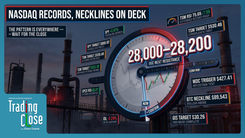
The technology-heavy QQQ ETF presents a far more stretched technical scenario. The index has maintained an incredible trajectory since its April 2025 lows, but it is now approaching a massive technical barrier: the bottom end of a parallel channel that has been intact since April of last year.
This ascending threshold sits at $708 today and moves to $708.90 tomorrow. The QQQ is currently overbought on both the daily and weekly timeframes. While overbought conditions can persist in strong bull markets, this specific trend line represents a critical juncture. Historically, when an index is severely overbought across multiple timeframes and approaches a multi-year structural resistance line, the probability of a sharp rejection or prolonged consolidation increases dramatically.
Meanwhile, the Russell 2000 (IWM) showed significant relative weakness, closing down 1.58%. The index printed a completely engulfing reversal candle, wiping out the previous day's gains. This type of candlestick pattern is a classic bearish signal, indicating a sudden and aggressive shift in sentiment. The near-term support for the IWM rests on an inclining trend line at $278.34, a level derived from pivots between November 2024 and January 2026. If that fails, the 50% area of the parallel channel at $271 becomes the next logical downside target.
The Software Surge: The Psychology of Profit-Taking
Earnings season always brings volatility, but today's action in the software sector provided a masterclass in trading psychology and the mechanics of gap-ups. Datadog (DDOG) and Fortinet (FTNT) both reported massive earnings beats, triggering violent upside moves that ultimately faced heavy intraday selling.
Datadog reported an 18.15% beat on earnings per share and a 4.82% beat on revenue, sending the stock up over 37% at its highs before closing with a 31% gain. Fortinet followed suit with a 32% EPS beat and a 6.72% revenue beat. However, despite these stellar fundamental numbers, both stocks encountered aggressive sellers as the day progressed.
This price action perfectly illustrates a core tenet of professional trading: the separation of fundamental news from technical reality. When a stock surges 30% to 40% in a single session, it creates a massive psychological burden on existing shareholders who suddenly find themselves sitting on life-changing short-term gains.
Drew addressed this psychological dynamic directly on the show:
"How can you just sit and let it go in one day and just continue to expect it to go to the moon? That's not how stocks work."
Institutional investors and seasoned traders understand that markets move in waves. A vertical move of this magnitude virtually guarantees profit-taking. As Drew wisely reminded viewers: "You're never going to go broke taking a profit."
From a technical perspective, Datadog is now facing a formidable triple-top resistance at $202. For traders looking to enter, chasing this extended move is a low-probability endeavor. The first level of support sits at $175.52, but a more conservative and higher-probability entry point lies at $161.24, which aligns with previous consolidation and a December 2024 pivot top.
Fortinet faces a similar setup, having pierced its double-top resistance at $114.82 before retreating. The stock left a massive unfilled gap all the way down at $90. In technical analysis, gaps act as magnetic voids on the chart. While Fortinet has near-term support at the psychological $100 level, traders must always factor in the worst-case scenario: a complete gap fill.
This software volatility spilled over into after-hours trading, with Cloudflare (NET) and CoreWeave reporting. Cloudflare is currently testing support at $220, with a critical gap fill looming at $205 and a major pivot at $200. CoreWeave, which was already overbought heading into earnings, is chopping sideways with overhead resistance at $143.01 and $153.20.
The Mega-Cap Race: Google vs. NVIDIA
One of the most fascinating underlying narratives in today's market is the race for market cap supremacy between Google (GOOGL) and NVIDIA (NVDA). For years, market participants have grown accustomed to NVIDIA wearing the crown, but the landscape is shifting rapidly.
Currently, Google boasts a market cap of $4.81 trillion, closing in on NVIDIA's $5.14 trillion valuation. While a $300 billion gap might seem insurmountable in traditional market environments, the explosive nature of these mega-cap tech stocks means this gap could close in a matter of weeks if current trajectories hold.
However, both stocks are facing distinct technical hurdles. Google is currently overbought in the near term and has broken above the top of its parallel channel. To maintain its bullish structural integrity, the stock likely needs to retrace and test the top of that parallel channel at $381, turning previous resistance into new support.
NVIDIA, on the other hand, executed a textbook technical bounce off a longer-term inclining trend line. The stock is now at a critical crossroads. To regain entry into its bullish parallel channel, NVIDIA must clear $216.50. Even if it achieves this, it immediately faces an inclining trend line of resistance at $217.37, created by connecting its previous and most recent all-time highs.
This creates a "double layer barrier" for NVIDIA. When a stock faces stacked resistance levels within a tight price range, it typically requires a massive catalyst or prolonged consolidation to build the necessary momentum for a breakout. How these two behemoths navigate their respective technical hurdles will likely dictate the broader direction of the Nasdaq in the coming weeks.
Commodities at a Crossroads: Precious Metals and Energy
The commodities complex provided some of the most compelling technical setups of the day, particularly in the precious metals sector. While both gold and silver have bounced from their recent lows, their technical postures are diverging in meaningful ways.
Gold is currently up 4.63% from its recent low. It managed to push through minor resistance at $4,588, but the broader structure remains a sideways, bearish consolidation. For the bulls to truly regain control of the gold chart, price action must achieve a daily close above the definitive line in the sand at $4,800. Until that level is breached, the probabilities continue to favor further downside pressure.
Silver, conversely, is showing immense relative strength, surging roughly 12% from its recent lows. The metal successfully flipped previous resistance into support at $75.33. To continue its bullish momentum, silver needs to attack and conquer the next major resistance level at $84.18. However, traders must remain vigilant; the broader pattern still echoes gold's bearish consolidation, with critical downside support resting on an inclining trend line at $68.81.
In the energy sector, US Oil is flashing a fascinating behavioral signal. Over the past two daily candles, oil has printed noticeable wicks at the bottom of its trading range. In candlestick analysis, lower wicks indicate that intraday selling pressure is being met with aggressive buying, effectively rejecting lower prices.
If oil can print a third consecutive wick tomorrow, it will heavily shift the probabilities in favor of an upside move to attack previous resistance at $107.48. This is a prime example of how professional traders use price action to gauge institutional footprint; consistent buying at a specific level over multiple days often precedes a structural reversal.
Natural Gas remains trapped in sideways chop. The commodity closed yesterday beneath its critical trend line at $2.90. To generate any actionable bullish momentum, natural gas requires not just a daily close above this line, but a confirming follow-through day—something it failed to achieve during its last breakout attempt.
The Crypto Complex: Bitcoin's Pivot and Coinbase's Gap
The cryptocurrency market continues to search for direction following a lackluster quarter of sentiment. Bitcoin, the bellwether of the space, closed down 1.55% today. After a powerful recent rally, Bitcoin is currently retracing and testing its previous pivot highs.
For near-term bulls, the absolute line in the sand is $79,523. This level represents the low of today's price action and serves as the structural foundation for the current leg up. If Bitcoin breaks below this level and the corresponding inclining trend line, it opens the door for a deeper retrace to longer-term support.
This sluggish crypto sentiment was reflected in Coinbase's (COIN) earnings reaction. Reporting after the bell, the stock dropped sharply to $184. The technical landscape below this level is precarious. There is an immediate gap fill target just under $175, specifically at $174.53. If that level fails to hold, the stock faces a technical void with little support until the next gap fill at $161. The ultimate line of defense for Coinbase lies on a longer-term inclining yellow trend line down at $148.45.
Trading earnings reactions in the crypto equity space requires extreme discipline. Because these stocks are essentially high-beta derivatives of Bitcoin's price action, their technical levels can break violently if the underlying asset experiences sudden volatility.
Looking Ahead: The Macro Catalyst
All of these technical setups—from the S&P 500's bear flag to the software sector's exhaustion—are converging on a massive macroeconomic catalyst: tomorrow morning's jobs report at 8:30 AM Eastern.
The labor market data has become the ultimate arbiter of market direction. As Drew highlighted, recent unemployment reports have actually been trending downward. However, this data may be masking a darker economic reality: the potential exhaustion of two-year unemployment benefits for a significant swath of the workforce. If individuals can no longer apply for benefits, they fall off the continuing claims radar, artificially suppressing the headline unemployment numbers.
Tomorrow's report will provide crucial clarity. Will the data confirm a resilient labor market, giving the Federal Reserve room to maintain restrictive policies? Or will it reveal underlying cracks that force a dovish pivot?
Professional traders do not guess the outcome of these reports. Instead, they map out the technical levels—like the QQQ's $708.90 channel bottom, or the S&P's 716.30 support—and wait for the market to reveal its hand. By combining the historical context of these levels with the psychological drivers of market participants, traders can position themselves to react logically, rather than emotionally, to whatever the data brings.
Trading involves substantial risk. All content is for educational purposes only and should not be considered financial advice or recommendations to buy or sell any asset. Read full terms of service.