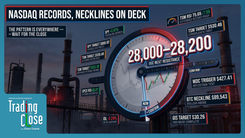

Trading The Close Market Recap - 06/01/2026: NVIDIA RTX Spark Ignites Semiconductor Surge — SMH Cycle Signals Possible Blow-Off Top

Monday’s session was dominated by AI-driven semiconductor momentum, but the rally was far narrower than the index highs suggested. NVIDIA’s Computex headlines—anchored by the RTX Spark, which Drew framed as a major step toward localized AI capabilities on personal computers—helped ignite another surge in chip-related names, while oil, yields, small caps, crypto, and metals told a more complicated story beneath the surface.
In this afternoon’s Trading The Close Market Recap, Pro Trader Drew Dosek at Verified Investing broke down the price action, the underlying technical structures driving these moves, and the critical levels traders must watch as this tech-led rally continues to unfold. Today’s article expands on these technical setups, exploring the historical cycles of the semiconductor market and the psychological discipline required to navigate a potential blow-off top.
The Tech-Led Surge and Market Divergence
The broader market indices painted a picture of sheer momentum today, but a look under the hood reveals a heavily concentrated rally. The Spiders (SPY) secured brand new all-time closing highs, establishing clear separation from a key inclining trendline that has served as near-term resistance since February.
“We did close up above this trendline now three days in a row without coming back to test it,” Pro Trader Drew noted, highlighting the sheer velocity of the move. With no overhead resistance in sight, near-term support for SPY now sits along the reclaimed trendline. Traders should watch that trendline closely if price begins to pull back.
The NASDAQ Composite (IXIC) echoed this strength, piercing through to all-time highs and reaching 27,190 points before pulling back slightly to close. Should selling pressure emerge as the week progresses, the NASDAQ has established a solid support floor at 26,635 points.
However, the day’s heat map revealed a fascinating divergence. While the tech sector was a sea of green, the rest of the market was painted red. This narrow breadth is a classic characteristic of a momentum-driven market where capital aggressively rotates into a single narrative—in this case, AI and the RTX Spark chip. This divergence was further complicated by geopolitical headwinds, proving that while tech can buoy the indices, the broader economy is still grappling with external pressures.
SMH Cycle Timing: Blow-Off Top or More Room to Run?
Perhaps the most compelling analysis from today’s show centered on the Semiconductor ETF (SMH). The SMH didn’t just make a new all-time high today; it continued to push the boundaries of its historical cyclicality. To understand the gravity of the current semiconductor rally, we have to look at the mathematical rhythm of its previous cycles.
Historically, SMH has seen major upside cycles followed by sharp 30% to 40% drawdowns. What makes this pattern notable is the duration of these runs. The first major cycle lasted 658 days. The subsequent cycle lasted 637 days—exactly a 21-day reduction.
“If we follow that same timeframe, a 616-day push higher would put us over here in December, guys,” Pro Trader Drew explained, pointing to a projected target date of December 14th. Drew framed this as a roadmap, not a guarantee—the cycle pattern offers a reference point, not a clock that must strike midnight.
Currently, the SMH is up an astounding 260% from its April lows, already exceeding the percentage gains of previous cycles. Yet, it continues to consolidate and build momentum at the highs. If this cyclical timing holds true, the market could continue to run into the winter months before a meaningful correction occurs. However, if the pattern breaks and profit-taking ensues early, traders must watch support at $545, followed by the top of the previous parallel channel at $521.[C1]
The SMH remains one of the clearest leading indicators for this market. As long as the semiconductors hold their ground, the broader tech rally remains intact. But if the SMH begins to falter, it will be the first major warning sign that equity bulls need to reduce risk.
Geopolitics, Yields, and the Broader Market
While tech investors celebrated the Computex announcements, the commodity and small-cap markets were digesting a very different reality. News broke today indicating that a peace deal in the Middle East is unlikely in the near term, sending US oil spiking over 7% in early trading.
Despite the dramatic headline, the technical structure of oil tells a story of bearish consolidation. Oil failed to reach the psychological $100 mark, pulling back and chopping sideways. Until oil can break above the $97.45 threshold, it remains in a bearish pattern with downside targets at $85.81 and $78.97. Conversely, if geopolitical tensions escalate further, a breakout above $97.45 would put the next major resistance at $107.48 in play.
This geopolitical tension weighed heavily on the Russell 2000 (IWM), which closed down 0.5% on the day. However, the small-cap index managed to recover from its intraday lows, largely thanks to a timely pullback in the 10-year Treasury yield.
The 10-year yield had surged early in the morning, putting pressure on equities, but was ultimately rejected at a key resistance trendline of 4.484%. It is now targeting lower support at 4.396%. This inverse relationship between yields and small-cap equities remains a critical intermarket dynamic. For the IWM, major support holds at $280, with upside resistance waiting at $296.66.
The AI Beneficiaries: Momentum and the Danger of Chasing
The individual stock reactions to the NVIDIA news were extreme. NVIDIA itself surged 6%, a massive move for a company of its market capitalization. In doing so, it obliterated three separate lines of technical resistance, including a sharp inclining trendline and a parallel barrier.
“Incredible push today on Nvidia on a technical basis. This shouldn’t have happened. That just shows you the momentum behind all of this positive news,” Pro Trader Drew observed. For the bulls, NVIDIA must now maintain separation from this parallel channel. If it fails, support levels await at $220 and $217.92.
Microsoft, NVIDIA’s partner in the new chip endeavor, pushed up 2.28%, breaking out of bullish consolidation. It now faces underside resistance from historical pivots, with a target of $490.58 at the 50% parallel mark. Any pullback offers a potential buying opportunity at the $430 support level.
The most explosive moves, however, came from hardware partners. Dell skyrocketed another 10%, moving from $317 to $420 in a breathtaking vertical climb. IBM mirrored this strength, surging from recent support at $225 straight into brand new all-time highs. IBM’s near-term support now sits at $288.36, with aggressive bulls watching the 50% parallel at $319.84.[C2]
Arm also joined the party, gapping up over its parallel channel to hit $385.41. As Pro Trader Drew explained, breaking through major resistance during regular trading hours requires immense volume and energy. Doing it after hours on lighter volume allows a stock to gap over the barrier and accelerate freely at the open.
From a psychological standpoint, these vertical moves create immense FOMO (Fear Of Missing Out) among retail traders. The urge to buy into a stock that is up 10% on the day is overwhelming. However, professional traders know that chasing extended moves can quickly destroy risk-reward.
Technical Education: Mastering Fibonacci for Entry Points
When a stock goes parabolic, traditional support and resistance lines often get left in the dust. How, then, does a disciplined trader find a safe entry point if they missed the initial breakout? The answer lies in Fibonacci retracements.
Using HPE as a textbook example, Pro Trader Drew demonstrated how to map out logical pullback zones. By drawing the Fibonacci tool from the most recent pivot low prior to the breakout up to the current high, traders can identify calculated support zones that many market participants and algorithmic systems may be watching.
“Well, the fibs produce calculated support levels, one of which institutions program in their algos to be active and buy at support levels,” he explained.
For HPE, this creates an aggressive entry level at the 23.6% retracement of $41.13, and a more conservative, higher-probability entry at the 38.2% retracement of $36.90. By waiting for price to return to these mathematically significant levels, traders remove emotion from the equation, avoid buying the top, and align their entries with institutional order flow.
The Other Side of the Trade: Competitors and Crypto Warnings
In the zero-sum game of market share, NVIDIA’s triumph was Intel’s pain. Intel faced selling pressure as the Computex news favored its direct competitors. However, the technical damage was contained, and Intel is now approaching a massive, multi-year inclining trendline dating back to May 2010. This critical support sits at $98.87, a level that should provide a near-term intraday bounce if tested.[C3]
Apple also found itself on the outside looking in, pulling back from its recent all-time highs. It is currently sitting directly on top of parallel support at $301.43, with overhead trendline resistance at $311.01.
The most severe technical breakdown of the day belonged to Meta, which plummeted 5.07%. This aggressive selloff erased a week of positive momentum and resulted in a failed breakout of its parallel channel.
“With failed moves, you see some of the biggest moves in the opposite direction,” Pro Trader Drew warned. Meta’s upside resistance is now firmly established at $618.72. Unless the bulls can reclaim this level, the probabilities heavily favor a continued drop down to test support at $585.68.
Meanwhile, the cryptocurrency market is flashing its own set of warning signs. Bitcoin has broken its primary inclining trendline and is currently testing secondary support for the third time. In technical analysis, the more times a support level is tested, the weaker it becomes. Bitcoin needs a major positive catalyst to reclaim the $73,173 level—its current line in the sand for bullish momentum. If this support fails, the next stop is the bottom of the parallel channel at $62,760.
In the precious metals sector, Gold remains under pressure, consolidating near the lower range of its channel. Support sits at $4,371, but a break here opens the door for a drop to the $4,200 level. Silver is painting a clear bear flag pattern; if it breaks its current trendline at $71.31, it is likely to flush down to major historical support at $66. Finally, Natural Gas saw a sharp rejection at $3.19, failing to re-enter its parallel channel, though it still maintains the technical posture to eventually attack resistance at $3.58.[C4]
Conclusion: Discipline in a Blow-Off Top Environment
As we navigate the remainder of the week, the tech sector’s explosive momentum will likely continue to dominate headlines. With more AI, robotics, and semiconductor news expected out of Computex, volatility is guaranteed.
While the current price action feels euphoric, traders must remain vigilant. This does not confirm a blow-off top, but the ingredients are present: narrow leadership, vertical moves, extreme momentum, and retail FOMO. In these environments, the difference between a successful career trader and a fleeting retail participant comes down to discipline.
Do not chase parabolic moves. Wait for the market to come to your levels. Utilize Fibonacci retracements to find logical entry points, respect your stop losses, and always trade based on probabilities rather than emotions. For traders looking to build that foundation, Verified Investing’s The Trader’s Core course is designed to help develop pattern recognition, money management, and logic-based trading discipline.
The market will always provide another opportunity. By staying patient and adhering to the technical levels mapped out in today’s Trading The Close Market Recap, you give yourself a better chance of participating in the next setup without becoming trapped in the current extreme.
Trading involves substantial risk. All content is for educational purposes only and should not be considered financial advice or recommendations to buy or sell any asset. Read full terms of service.