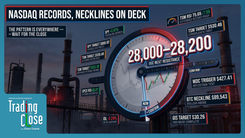

Trading The Close Market Recap - 06/02/2026: AI & Semiconductor Euphoria, Tech Divergence and Bitcoin Breakdown

Markets pushed to fresh highs, but the rally underneath the surface was far less balanced than the index levels suggested. Semiconductors continued their AI-driven surge, QQQ outperformed the broader Nasdaq, Bitcoin broke key support, and commodities remained trapped in technical compression. In today's Trading The Close Market Recap, Pro Trader Drew Dosek broke down the levels that matter now.
Index Divergence: The Tale of Two Tech Markets
The broader market indices are currently flashing a textbook example of technical divergence. The S&P 500 closed the session at 759.57, continuing its float above an inclining trend line. That upward drift, however, is losing velocity. The index is sitting less than six points from trend line support at 754.21 — not the kind of aggressive extension you'd expect at all-time highs.
More concerning for the bulls is the glaring daily divergence on the RSI.
"We've got daily divergence going on down here with the RSI… it's telling me we likely should not be continuing to drift higher," noted Pro Trader Drew. "We need a period of consolidation to work off this overbought scenario that we've been in the S&P 500 since April 17th."
When an index continues to make higher highs while its momentum oscillator makes lower highs, it signals that the underlying buying pressure is waning. The S&P 500's weekly chart shows a relentless string of green candles — but the next psychological resistance sits at 770 if the market pushes higher, and the divergence remains unresolved.
This exhaustion is further highlighted by a split inside the technology sector itself. While the QQQ ETF (representing the Nasdaq 100) pushed into all-time highs and re-entered its parallel channel, the broader Nasdaq Composite (IXIC) failed to make a new high. The distinction matters. The QQQ's strength is heavily concentrated in the top 11% of Nasdaq stocks. When a rally narrows to a handful of mega-cap names while the broader index lags, it often precedes rotation or correction. For traders watching the Qs, support sits at an inclining trend line at $730.95, followed by the bottom of the parallel channel at $727.40. The IXIC will look for primary support at 26,673 points.
Semiconductor Euphoria and the Dot-Com Parallel
Nowhere is the current market dynamic more evident than in the semiconductor space. The SMH (Semiconductor ETF) is in the middle of a powerful AI-driven run. Since its low pivot in April of last year, the SMH has surged 271%.
Historical context makes that number meaningful. Previous semiconductor super-cycles have typically seen pushes of around 230% before a 30% to 40% cyclical decline. The current cycle has already exceeded those norms.
"This is truly historical," Pro Trader Drew noted. "We generally are pushing up 230% or so before we have a 30 to 40% decline. We're extending this push up now 271% up since this low pivot here in April."
When retail investors who don't typically follow markets start asking for picks in a specific sector, it is often a contrarian signal near a short-term top. But the key distinction here is the difference between a cyclical correction and a secular trend change. Pro Trader Drew drew a useful parallel to the dot-com era. While that bubble caused massive near-term declines, the underlying technological revolution of the internet continued for decades. A 30% pullback in the SMH — with first support around $580 — would not mean the end of AI. It would be a technical reset within a longer-term structural shift.
The Psychology of Earnings: Exit Liquidity and Profit Taking
Earnings season in an extended market creates volatile price action, and the reports from Marvell Technology (MRVL) and Hewlett Packard Enterprise (HPE) illustrated that clearly.
MRVL experienced an explosive gap-and-go rally, pushing to roughly $300 in after-hours trading, catalyzed in part by Nvidia CEO Jensen Huang's comment that Marvell is likely on its way to becoming a trillion-dollar company. The fundamental narrative is compelling — but the technical picture is flashing warnings. MRVL's weekly RSI hit 94.64, with the monthly RSI at 85.16.
In practice, exit liquidity means late buyers provide the volume that earlier buyers need in order to take profits. Pro Trader Drew put it plainly:
"This is the exit liquidity," he warned. "When this making the news, making this big of a pop, there's going to be profit takers. It's just a matter of when and where that price can come down once everybody rushes for the same small exit door."
When a stock becomes headline news after a vertical move, late buyers often provide the liquidity that earlier buyers use to take profits. That does not mean the stock must immediately collapse — but it does mean the risk-reward has changed. If MRVL recoils, first support sits at an inclining parallel around $243, with a deeper trend line target at $205.12.
The danger of chasing extended moves was also on display with HPE. Despite reporting a significant earnings beat, the stock surged as much as 37% intraday before suffering a 12% decline from top to bottom, eventually closing up 19.47%.
"You don't go broke taking a profit," Pro Trader Drew reminded viewers. "Be smart about your positions as this is starting to get really out of control, blowing through technicals and really fundamentals like nothing I've seen before."
Palo Alto Networks (PANW) similarly surged from a $297 close to $340 in after-hours trading following earnings. The fundamental thesis is solid — as AI and quantum computing evolve, cybersecurity becomes a growing necessity. But traders need to wait for proper technical setups rather than chasing parabolic after-hours moves.
Commodities: Moving Averages as Training Wheels
The commodities market is presenting technical setups worth monitoring, particularly in precious metals.
Pro Trader Drew offered a grounding analogy for moving averages: "In my mind, they're like training wheels to help you see where the trend is going and also to help you spot a top in the trend."
Gold has been chopping sideways, creating a wedge between two major moving averages. The 50-day MA is acting as resistance, having rejected price on both April 17th and May 12th. The 200-day MA is moving upward as support. This compression will force a decisive breakout in the coming sessions. With gold consolidating just above support, the probabilities slightly favor a breakdown. If the parallel channel breaks, the next major support target is $4,189. Any bullish push would first need to clear horizontal resistance at $4,800.
Silver is showing similar sideways chop on support — a pattern that often foreshadows a breakdown. Immediate support rests at $71.50, a level already tagged on May 28th. Because that level has been tested, its structural integrity is weakened. A break below $71.50 opens the door to the March 23rd pivot low at $61.02. For long-term physical accumulators, the prime buy zone sits sub-50% of the parallel channel, around the $55 range.
In the energy sector, U.S. Oil ignored geopolitical headlines around the Middle East and the Strait of Hormuz, forming a 10-minute bull flag and pushing higher — a clear example of price action superseding news narrative. Resistance sits at $85.81. If the geopolitical premium washes out, oil could test $78.97, with a longer-term measured move down to $69.59. Any drop to the $78 range, however, could attract buying as nations restock depleted strategic reserves.
Natural gas is attempting to bounce from the bottom of its parallel channel. The $3.32 level is key — failure to reclaim momentum could see prices slide to near-term support at $2.90.
Bitcoin's Technical Breakdown
Crypto provided one of the most significant technical developments of the session. Bitcoin dropped roughly 6%, confirming a breakdown of a major inclining trend line the Trading The Close team had been tracking.
Bitcoin's daily RSI has now moved into oversold territory at 22.44. An RSI below 30 often precedes a near-term relief bounce. Aggressive traders might target previous low pivots at $64,938 and $64,068 — but that bounce would likely only serve to retest the broken trend line from underneath, the classic bearish confirmation signal.
The broader structural concern is a massive head-and-shoulders formation. If the current parallel channel breaks, the measured move points to a significant downside target.
"That will put us down near our head and shoulders target, which is sub $40,000," Pro Trader Drew stated. "I know when I came out with this target several months ago, I got a lot of backlash… Incredible how technical analysis works."
The lesson holds regardless of asset class: the market does not care about emotional attachment. When technical patterns dictate a measured move, ignoring them due to fundamental bias is a costly mistake.
Bitcoin's breakdown is already rippling through proxy stocks. MicroStrategy (MSTR) fell 9.15% on the day and is approaching horizontal support around $131.50. If Bitcoin flushes toward its sub-$40,000 target, MSTR will likely test $113.69 before the more significant level at $73.78.
The Next Frontier: Energy Infrastructure and Quantum Computing
As the AI narrative matures, forward-looking traders are already watching the secondary and tertiary beneficiaries. Data centers are power-hungry, making energy infrastructure a critical bottleneck.
Bloom Energy (BE) is consolidating for a potential breakout. With inclining parallel resistance at $319.76 and all-time high resistance at $322.83, its RSI sits at a comfortable 60.23 — room to run. A break of the parallel opens upside targets at $367.40 and $417. However, traders should monitor the weekly topping tail closely; BE needs a weekly close above $310 to negate that bearish signal and confirm the upward trajectory. LITE pushed up 13.72% on the session, targeting the top of its parallel at $1,133, with a speed bump at $1,085.
Quantum computing is the further-out theme. While MRVL and HPE are going parabolic, quantum names have been quietly bottoming.
"This is a longer term buy and hold because quantum computing will be the next step and will take us beyond AI," Pro Trader Drew explained.
RGTI is forming a bull flag after breaking a long-term downtrend. If the flag plays out, targets sit at $30 and $34–$35, with support at $21.06 on failure. QBTS, with strong university contracts, demonstrated a textbook breakout-and-retest setup — breaking its downward consolidation, pulling back to the parallel channel, then bouncing. It faces support at $25.74, with upside targets at $33.76 and previous all-time highs near $46.80.
These names represent early-stage watchlist names, provided the technical setups continue to confirm.
Conclusion: Discipline in the Face of Euphoria
The current environment is a test of discipline. Semiconductors are running hot, earnings are producing massive gaps, and major indices are pushing into new territory. But beneath the surface — in the RSI divergences, the narrow leadership, the Bitcoin breakdown, and the commodity compression — the charts are telling a more complicated story.
Strict technical analysis — mapping support and resistance, respecting measured moves, using moving averages as a framework — is what separates traders who navigate this moment from those who become the exit liquidity for the ones who got in earlier. Whether the trade is in parabolic AI momentum, precious metal wedges, or early-stage quantum setups, the approach is the same: remove the emotion, manage the risk, and let the charts lead the execution.
Trading involves substantial risk. All content is for educational purposes only and should not be considered financial advice or recommendations to buy or sell any asset. Read full terms of service.